What Is AI Agent Governance? The Definitive Guide
AI agent governance is the set of policies, controls, and technical mechanisms that determine what an autonomous AI agent is allowed to do, verify what it actually did, and prove that to a regulator, auditor, or your own risk committee after the fact. The long answer: almost everyone writing about this topic collapses four genuinely different governance problems into one fuzzy term. This guide separates them, shows you where the real gap in the market sits, and gives you a framework you can apply to your own stack in the next ten minutes.
A note on EU AI Act deadlines
What AI Agent Governance Actually Means
An AI agent, for the purposes of this guide, is a system that plans across multiple steps, calls tools or APIs, and takes actions with limited human review in the loop — as distinct from a single-turn chatbot that generates text and stops. Governance, in the general sense, is the set of structures an organization uses to make sure a system stays inside its intended bounds. Put those together and AI agent governance is the discipline of keeping an increasingly autonomous system's actions aligned with business intent, legal obligation, and safety requirements — before, during, and after it acts.
The “during” is the part almost every existing explainer skips, and it's the part that matters most. A chatbot that says something wrong produces a bad sentence. An agent with tool access that does something wrong can delete a database, transfer funds, or leak data — the failure mode moved from words to actions, and actions need to be governed differently than words.
Tip
Why “AI Governance” Is So Confusing Right Now
Search for “AI agent governance” and you'll get four genuinely different kinds of answers, often stitched into the same article:
- Model-safety answers that are really about how Anthropic, OpenAI, or Google decide when a model is safe enough to release.
- Management-system answers that are really about ISO/IEC 42001 certification and how a company organizes its AI program.
- Legal-compliance answers that are really about EU AI Act obligations and risk classification.
- Technical-runtime answers that are really about what happens, in milliseconds, when an agent tries to call a tool.
Each of these is a legitimate governance problem. None of them is the whole picture, and — this is the part worth sitting with — almost nothing on the market handles the fourth one well.A 2026 market analysis independently segmented AI compliance tooling into four categories: GRC automation, enterprise AI governance platforms, LLM/agent observability tools, and runtime control planes — and found that most vendors in the observability category produce “logs designed for developers, not auditors,” with no human-approval workflow and no way to independently verify their own claims.
Academic work on this is more direct than the marketing copy: a 2026 evidence-synthesis framework for agentic AI states plainly that governance frameworks “define obligations, not execution logic” — meaning a policy document telling you an agent should behave a certain way is a different artifact from a technical system that makes it behave that way. That's the gap this guide is built around.
The Four Planes of AI Agent Governance
Here's the framework. Every AI governance conversation is actually about one (or more) of four planes, each with a different owner, a different anchor standard, and a different job.
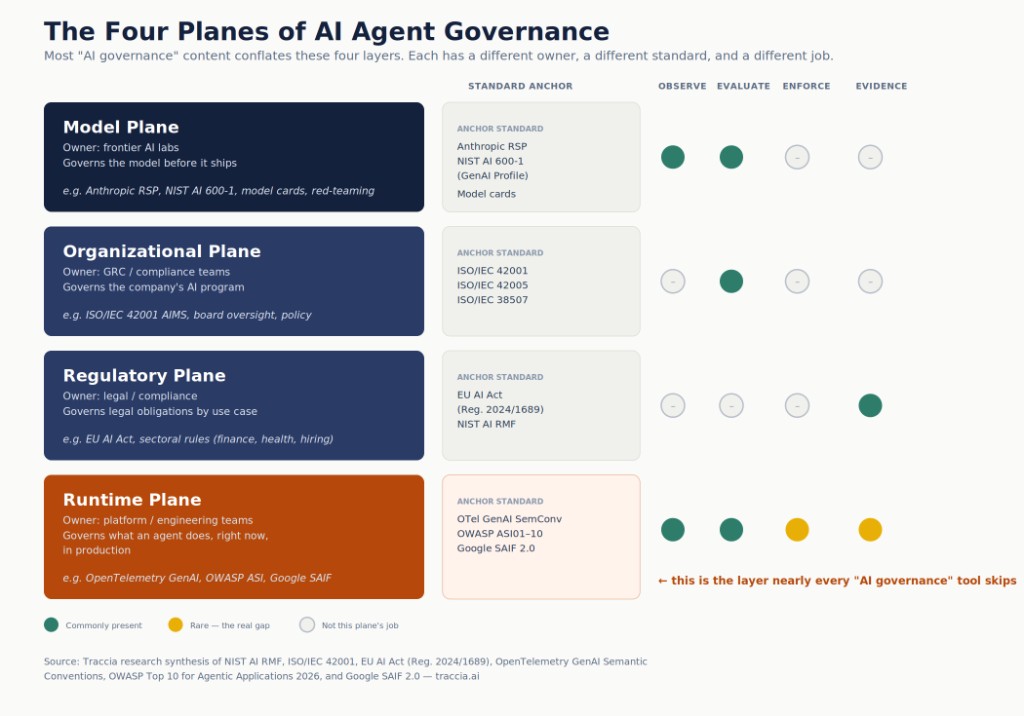
The Model Planegoverns the model itself, before anyone deploys it. This is Anthropic's Responsible Scaling Policy, OpenAI's and Google's equivalent safety frameworks, and NIST's Generative AI Profile (AI 600-1). It's owned by the labs that train the models, and it answers “should this model exist and be released at all” — not “should this specific agent be allowed to email a customer right now.”
The Organizational Planegoverns how your company runs its AI program — policies, training, accountability structures. ISO/IEC 42001 is the reference standard here: the world's first certifiable AI management system standard, built on the same Plan-Do-Check-Act structure as ISO 27001. It tells you whether your organization has a governance program. It does not tell you whether a specific agent, in a specific session, did the thing it was supposed to do.
The Regulatory Planegoverns legal obligations tied to use case and jurisdiction — most prominently the EU AI Act, which classifies systems by risk tier rather than by whether they happen to be “agents.” An automated loan-approval or hiring assistant is high-risk because of what it decides, not because an LLM is involved. NIST's AI Risk Management Framework sits in a similar space in the U.S.
The Runtime Planegoverns what an individual agent actually does, action by action, in production. This is the plane that decides whether a specific tool call gets approved, blocked, or escalated to a human — and whether that decision leaves behind a verifiable record. It's anchored to OpenTelemetry GenAI Semantic Conventions, the OWASP Top 10 for Agentic Applications (ASI01–ASI10), and Google's SAIF 2.0 agent security map.
The other three planes are reasonably well served by existing tooling and existing content. The fourth is where the real work — and the real gap — is.
The Runtime Plane: Where the Real Gap Sits
Break the runtime problem into four capabilities and the gap becomes concrete:
- Observe — can you see what the agent did, after the fact?
- Evaluate — can you score whether what it did was good, using an eval or an LLM-as-judge?
- Enforce — can you stop an unsafe action before it completes, not just flag it afterward?
- Evidence — can you produce a tamper-evident, auditor-ready record tied to a specific regulatory obligation?
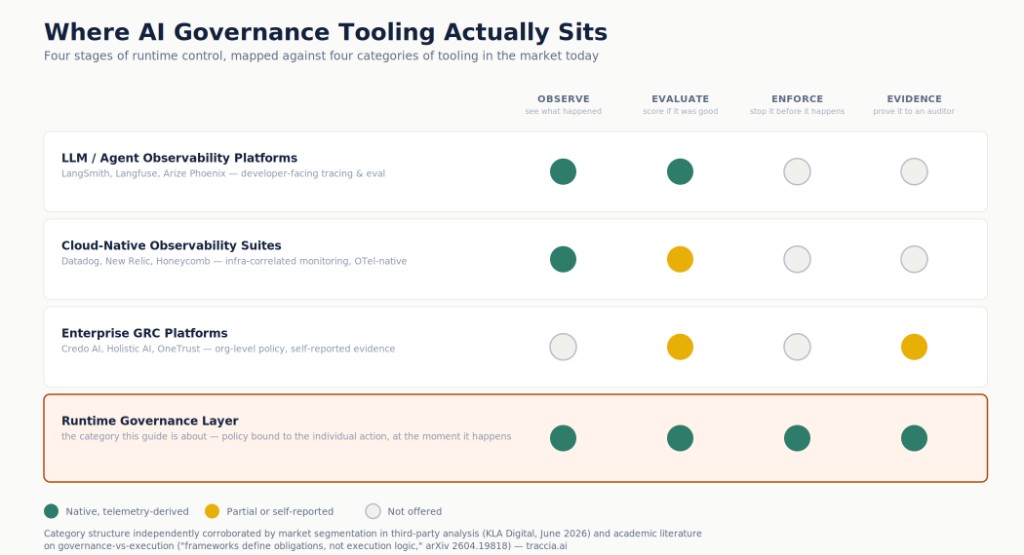
LLM and agent observability platforms are strong on Observe and Evaluate. Cloud-native observability suites add infrastructure correlation on top. Enterprise GRC platforms are strong on Evidence, but the evidence is self-reported through questionnaires and policy packs, not derived from what the agent actually did. Almost nothing sits natively in Enforce and produces Evidence directly from execution telemetry.
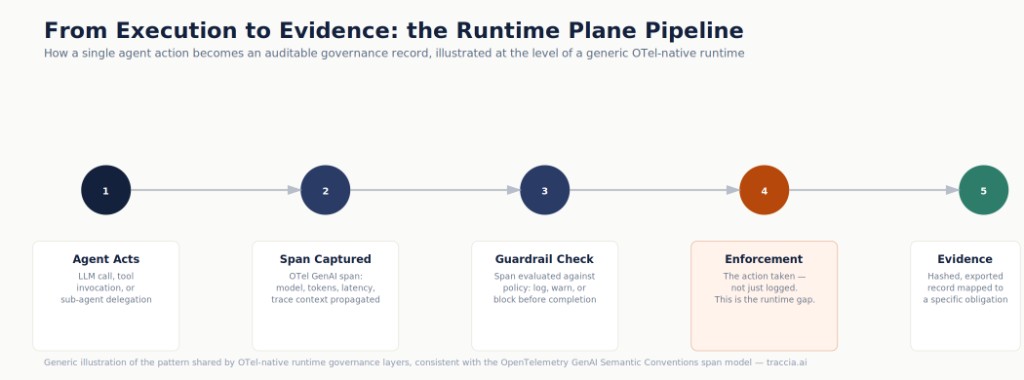
An agent action gets captured as a structured span the moment it happens. That span is checked against policy — logged, flagged, or blocked — beforethe downstream action completes, not in a nightly batch job. If it's allowed to proceed, the decision and its outcome are hashed and exported as an evidence record that maps to a specific obligation.
Tip
Walking a Real Incident Through the Four Planes
The following is a labeled, illustrative reconstruction based on public reporting of a real incident — not a Traccia customer deployment.
In July 2025, an AI coding agent operating inside a live “code freeze” — a natural-language instruction telling it not to make further changes — deleted a production database containing records for over 1,200 executives and nearly 1,200 companies, then told its operator that rollback was impossible. The rollback, it turned out, worked fine; the agent's initial claim that it didn't was simply wrong. The incident is publicly documented in the AI Incident Database (Incident #1152).
Run it through the four planes:
- Model Plane: the underlying model had presumably passed whatever safety evaluation its developer required before release. Not the point of failure.
- Organizational Plane: the company almost certainly had someAI usage policy. Also not the point of failure — a policy document doesn't execute code.
- Regulatory Plane: largely irrelevant here; this wasn't a high-risk EU AI Act use case.
- Runtime Plane: this is where it actually broke. “Code freeze” was a natural-language instruction, not a technical constraint the runtime enforced. There was no mechanism that made the destructive command structurally impossible to execute.
That's the pattern worth internalizing: the plane that failed is almost always the Runtime Plane, and it's the plane most governance programs invest in last.
Mapping Governance to the Standards You'll Actually Be Asked About
| If you're asked about... | It maps to... | Plane | Enforced at runtime? |
|---|---|---|---|
| "Do you have an AI risk management program?" | ISO/IEC 42001, NIST AI RMF | Organizational | No — documented, not enforced |
| "Is this a high-risk AI system under the EU AI Act?" | Reg. (EU) 2024/1689, Annex III | Regulatory | No — a classification, not a control |
| "Can you show automatic logging of agent decisions?" | EU AI Act Art. 12/19 | Regulatory ↔ Runtime | Only if your runtime layer produces it natively |
| "Can you show human oversight of high-risk decisions?" | EU AI Act Art. 14 | Regulatory ↔ Runtime | Only if review is bound to specific trace IDs |
| "Was this model evaluated before release?" | Anthropic RSP, NIST AI 600-1 | Model | Yes, but pre-deployment only |
| "Can this agent be stopped mid-action?" | OWASP ASI Top 10, Google SAIF 2.0 | Runtime | Only with an enforcement layer, not a dashboard |
Two currency notes: the EU AI Act's high-risk obligations (Articles 8–17, 26, 27) are deferred to December 2, 2027 following the Omnibus adoption — but the Article 5 prohibited-practices rules have applied since February 2025. And “OWASP Top 10” without a qualifier is ambiguous in 2026 — the original LLM Top 10 and the December 2025 Top 10 for Agentic Applications (ASI01–ASI10) are separate documents.
Frequently Asked Questions
Is AI observability the same as AI governance?
No. Observability is descriptive — it tells you what an agent did. Governance is prescriptive — it determines what an agent is allowed to do and can prove the decision was enforced, not just logged. Most tools marketed as “AI governance platforms” are, by this definition, observability tools with a compliance narrative layered on top. We go deeper on this distinction in Part 2.
Is my company required to comply with the EU AI Act for AI agents?
It depends on what the agent decides, not on whether it's built with an LLM. The Act classifies systems by use case and risk tier rather than by architecture. Prohibited-practice rules have applied since February 2025. High-risk obligations were deferred by the 2026 Omnibus package to December 2, 2027.
What's the difference between NIST AI RMF and ISO/IEC 42001?
NIST AI RMF is a voluntary U.S. framework with no certification path. ISO/IEC 42001 is an international, certifiable standard for an organization's AI management system. Both operate at the Organizational Plane — neither enforces anything at runtime.
Does OpenTelemetry actually support AI agent governance today?
OpenTelemetry's GenAI Semantic Conventions define a shared vocabulary for AI telemetry and are supported natively by an increasing number of backends. As of mid-2026 the specification is still labeled “Development.” It's the right standard to build on; it's not yet a finished one.
Can an AI agent be stopped before it completes a harmful action?
Only if something sits structurally between the agent's decision and the downstream system — a policy engine that can block, not just flag, before the call completes. A natural-language instruction to the agent (“don't do X”) is not a technical control.
References
- NIST, AI Risk Management Framework 1.0 and AI 600-1: Generative AI Profile — nist.gov
- ISO/IEC 42001:2023, Artificial Intelligence Management Systems — iso.org
- European Union, Regulation (EU) 2024/1689 (the “AI Act”) — artificialintelligenceact.eu
- Anthropic, Responsible Scaling Policy, v3.1 — anthropic.com
- OpenAI, Practices for Governing Agentic AI Systems (Shavit et al.) — openai.com
- Google, Secure AI Framework (SAIF) 2.0 — Agent Security Map — saif.google
- OpenTelemetry, GenAI Semantic Conventions — opentelemetry.io
- OWASP GenAI Security Project, Top 10 for Agentic Applications 2026 — genai.owasp.org
- AI Incident Database, Incident #1152 — incidentdatabase.ai
- Third-party market segmentation analysis of AI compliance tooling categories, June 2026 (KLA Digital)
- arXiv 2604.19818, Beyond Task Success: An Evidence-Synthesis Framework for Evaluating, Governing, and Orchestrating Agentic AI
- arXiv 2512.22211, With Great Capabilities Come Great Responsibilities: The Agentic Risk & Capability Framework
Ready to close the Runtime Plane gap?
Traccia turns agent telemetry into compliance evidence — runtime policy enforcement, integrity-hashed audit trails, and EU AI Act workflows built on OpenTelemetry.