AI Observability vs AI Governance: What's the Difference?
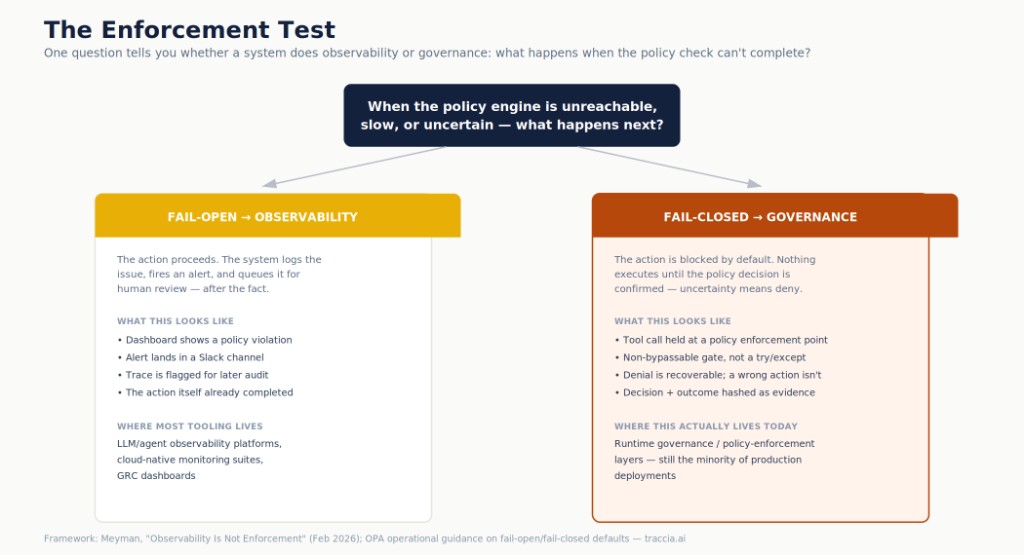
AI observability and AI governance are not the same thing, and the difference isn't philosophical — it's testable. Ask any tool one question: when a policy check can't be completed — the engine is down, the check is slow, the answer is uncertain — does the action go through anyway, or does it get blocked? If it goes through, you're looking at observability wearing a governance costume. If it's blocked by default, you're looking at governance.
Part 1: What Is AI Agent Governance?
If you read Part 1 of this series, you already have the vocabulary: observability and governance aren't competing categories, they're different planes doing different jobs, and most of the confusion in this space comes from marketing copy that uses “governance” to describe what is, technically, very good logging.
The One-Question Test
A February 2026 working paper gave this problem the clearest treatment we've found: it formalizes the distinction along what the author calls enforcement locus, failure behavior, and bypass resistance, then reduces the whole question to a six-criterion pass/fail protocol. A system either implements authorization governance — a non-bypassable gate that binds every action to policy and fails closed under uncertainty — or it implements compliance engineering: evidence-routing, alerting, and review queues that are valuable, well-built, and not the same thing.
The plain-language version: observability governs accounts of action — what happened, and how it can be reconstructed. Governance governs permission to act — whether a specific action was allowed before it executed. A system can generate extensive documentation, cryptographic signing, and beautiful dashboards and still fail open — meaning when something goes wrong with the check itself, the default is to let the action through and log the problem, not stop it.
Tip
What Observability Actually Does
Observability — logs, metrics, and traces, adapted for non-deterministic AI workloads — answers “what happened and why.” For an LLM or agent, that means capturing prompts, completions, tool calls, token usage, and latency as structured spans, typically via the OpenTelemetry GenAI Semantic Conventions covered in Part 1.
This is genuinely valuable, and it is the foundation everything else is built on — you cannot enforce a policy you cannot see a violation of. Distributed tracing turns a black-box agent decision into a reconstructable narrative: which tool was called, what arguments were passed, what came back, how long it took, what it cost. Most of the LLM/agent observability category — LangSmith, Langfuse, Arize Phoenix, and the AI-specific tooling inside cloud-native suites like Datadog — does this well, and does it as its actual job, not a side effect.
What it doesn't do, structurally, is stand between the agent and the action. The failure mode is characteristic and consistent across the category: when a governance condition isn't met, the system logs the issue, fires an alert, escalates to a review queue — and the underlying action continues unless a human manually intervenes in time. That's fail-open by design, because these tools were built to help you understand and debug a system, not to gate it.
What Governance Actually Requires
Governance, by the test above, requires an enforcement point that sits structurally between the agent's decision and the downstream system — what security architecture calls a policy enforcement point. Three properties distinguish it from an observability layer wearing a governance narrative:
- It's a gate, not a queue. The action does not proceed until the policy decision resolves. A queue for human review, however fast, is still fail-open in the interval before a human looks at it.
- It fails closed. Under uncertainty — the policy service is slow, unreachable, or the input is ambiguous — the default is deny, not allow. In an agentic context a denied action is recoverable while an unauthorized one may not be.
- It's non-bypassable. A
try/exceptaround a policy check that defaults to “allow” on any exception is not a governance control — that pattern is one of the most dangerous bugs an agent runtime can ship with, because it looks like resilience and behaves like a backdoor.
None of this makes observability tooling less valuable — it makes it a different layer with a different job. The mistake is treating a dashboard as a control.
Why the Gap Is Measured in Milliseconds, Not Philosophy
This distinction isn't academic hair-splitting — it's a latency problem with a measurable cost. A 2026 study benchmarking closed-loop enforcement against a standard OpenTelemetry-plus-Langfuse observability baseline found that baseline took roughly 15 seconds to detect a policy violation in a multi-agent system — meaning the violating action had already completed well before anything flagged it. An enforcement layer that binds policy to the action itself, by contrast, held decisions to well under 200 milliseconds, and cut the “escape rate” — the share of violations that complete before anything stops them — by 97.6% relative to the observability-only baseline.
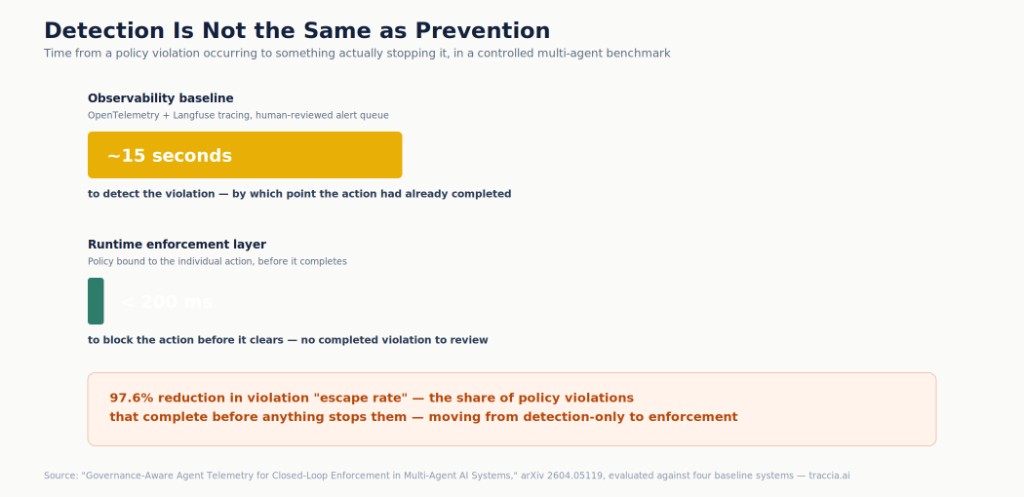
The physical reason is simple: a violation that routes an EU citizen's data to the wrong region, or lets an agent execute a destructive command, doesn't wait for a dashboard review. It happens in milliseconds. A system that only detects violations after they complete isn't a weaker version of a governance system — it's answering a different question.
Case Study: EchoLeak and the Limits of Detection
The following is a factual reconstruction based on public security research and Microsoft's own disclosure — not a Traccia customer incident.
In mid-2025, researchers at Aim Security disclosed a vulnerability in Microsoft 365 Copilot — tracked as CVE-2025-32711 and nicknamed “EchoLeak,” rated critical at CVSS 9.3 — that let an attacker exfiltrate sensitive internal data with a single crafted email and zero clicks from the victim. The mechanism is instructive for exactly the distinction this chapter is about.
Microsoft had a detection layer in place: a classifier (XPIA, for cross-prompt injection attempts) specifically built to catch indirect prompt injection. The attack didn't disable that classifier — it was engineered to evade it, along with Copilot's link-redaction filter and its content security policy, by chaining several bypasses together. Once those detection layers were evaded, nothing else stood between the malicious instruction and the outbound data — the architecture had observability and classification, but no fail-closed gate that could hold the action if the classifier was wrong.
Run this through the Part 1 framework: the Model Plane and Organizational Plane weren't the point of failure. It was a Runtime Plane gap, and specifically an enforcement gap: detection existed, evasion of that detection was possible, and there was no second, structurally independent layer that failed closed when the first one was fooled. The underlying lesson — that a classifier is a detector, not a gate — applies to any RAG-based agent, not just Copilot.
Where Common Tools Actually Sit
| Category | Examples | Native enforce (fail-closed)? | Evidence from execution? |
|---|---|---|---|
| LLM / agent observability | LangSmith, Langfuse, Arize Phoenix | No — flagging and review queues | No — logs, not compliance artifacts |
| Cloud-native observability | Datadog, New Relic, Honeycomb | No — alerting and correlation | Partial — infra-grade, not regulation-mapped |
| Enterprise GRC platforms | Credo AI, Holistic AI, OneTrust | No — organizational policy layer | No — self-reported via questionnaire |
| Policy engines / gateways | Open Policy Agent, AI gateways | Yes, if configured fail-closed | Depends on integration |
| Runtime governance layers | OTel-native enforcement + evidence | Yes, natively | Yes — hashed, execution-derived |
This isn't a knock on any specific product — it's a description of category design intent. The practical takeaway: know which question your current stack actually answers before you tell an auditor it does both.
Frequently Asked Questions
Is AI observability a prerequisite for AI governance?
Yes. You cannot enforce a policy you can't detect a violation of, and you cannot produce evidence from telemetry you never captured. Observability is necessary but not sufficient — it's the input layer governance builds on, not a substitute for it.
Can I add enforcement to my existing observability tool?
Only if the tool sits inline, before the action completes, and can fail closed. Most agent observability platforms are architected as sidecars that receive telemetry after or alongside execution. Check whether your tool can block, not just flag — that's the test from this guide.
What does “fail closed” mean in practice for an AI agent?
It means that when the system can't confirm an action is authorized — the policy engine is unreachable, the check times out, the input is ambiguous — the default behavior is to deny the action, not allow it. The alternative (“fail open”) lets the action proceed and logs the problem for later review.
Does the EU AI Act require enforcement, or is logging enough?
The Act's human-oversight and logging articles (12, 14, 19) require that organizations can demonstrate oversight and produce records — they don't mandate a specific technical architecture. In practice, though, “demonstrate human oversight of a high-risk decision” is a much easier claim to support with a system that can hold an action for review than one that can only show you a log of what already happened.
Is Datadog or LangSmith an AI governance platform?
By the fail-open/fail-closed test, no — both are excellent, purpose-built observability and evaluation platforms, and neither is architected as a policy enforcement point that blocks actions before they complete. That's a description of their design intent, not a criticism.
References
- Meyman, E., Observability Is Not Enforcement (SSRN / Zenodo, February 2026)
- arXiv 2604.05119, Governance-Aware Agent Telemetry for Closed-Loop Enforcement in Multi-Agent AI Systems
- Reddy, P. et al., EchoLeak: The First Real-World Zero-Click Prompt Injection Exploit in a Production LLM System, arXiv 2509.10540
- Microsoft Security Response Center, CVE-2025-32711 disclosure
- Aim Security, EchoLeak research disclosure (aim.security)
- Open Policy Agent, operational documentation on fail-open/fail-closed decision responsibility — openpolicyagent.org
- OpenTelemetry, GenAI Semantic Conventions — opentelemetry.io
- Third-party market segmentation analysis of AI compliance tooling categories, June 2026 (KLA Digital)
- arXiv 2606.12320, A Five-Plane Reference Architecture for Runtime Governance of Production AI Agents
See both layers in one stack
Traccia combines OpenTelemetry-native observability with runtime policy enforcement — tracing, guardrails, and audit-ready evidence in one SDK.