Maxim Alternative
Traccia vs Maxim
Maxim helps you simulate, evaluate, and observe agent quality. Traccia helps you observe agents, enforce policy at the agent boundary, and prove what happened. Enforce, not just observe.
Introduction
Maxim is an end-to-end platform to simulate, evaluate, and observe AI agents: Playground++ for prompt iteration, large-scale agent simulation, offline and online evaluators, human review pipelines, and production tracing with quality/safety alerts. Maxim also ships Bifrost (LLM gateway) and no-code collaboration for product teams. This comparison focuses on production observability and governance.
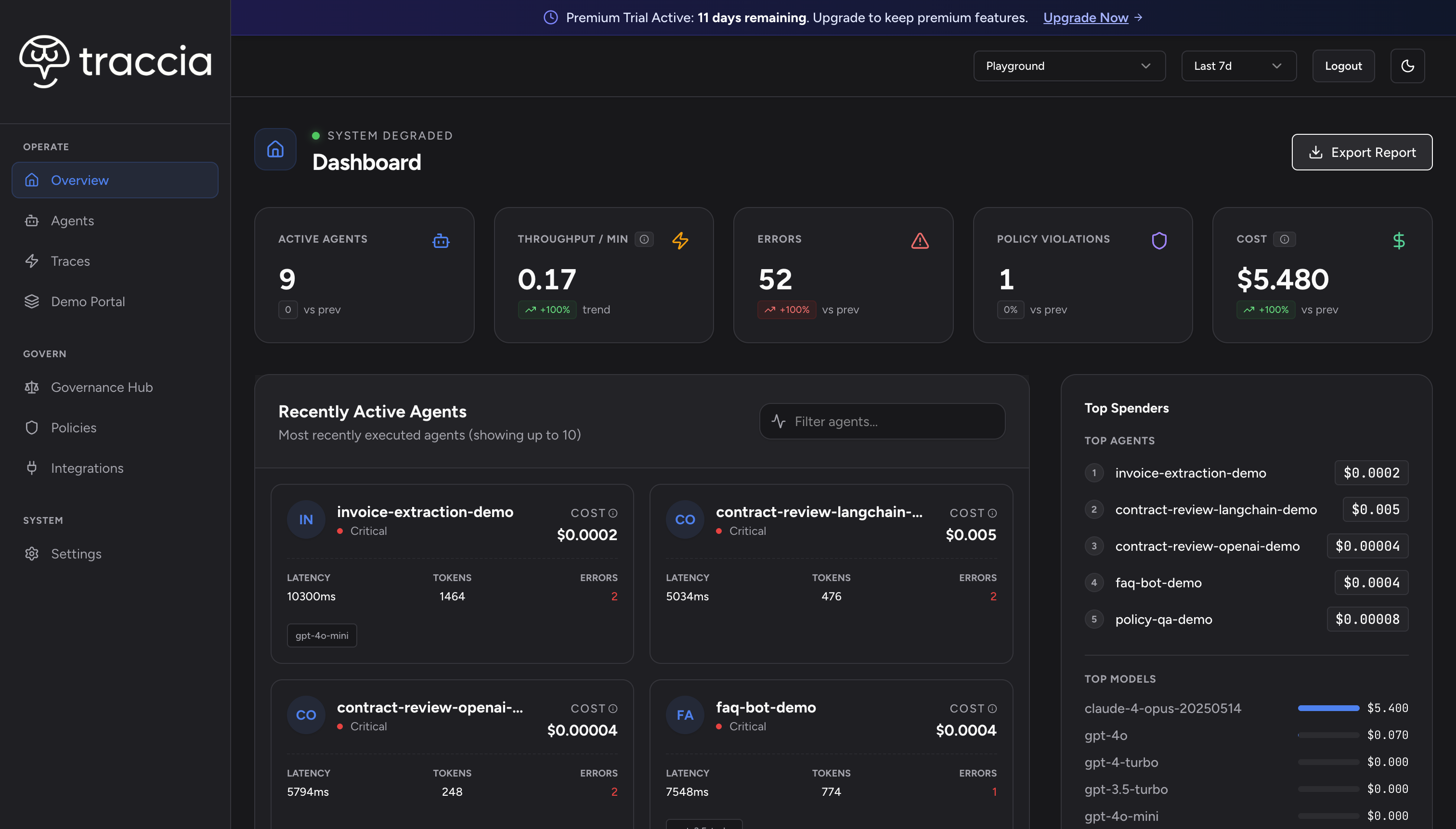
Traccia is the developer runtime control plane. Philosophy: Visibility → Intelligence → Control → Certification. Enforce, not just observe. Instrument once with OpenTelemetry, attribute cost accurately under sampling, define operational policies, gate agents with @govern, and export evidence from the same spans, without becoming a simulation studio.
At a Glance
A side-by-side view of how Maxim and Traccia differ on the dimensions that matter for production AI systems.
| Dimension | Maxim | Traccia | Edge |
|---|---|---|---|
| Layer of the stack | Simulate → evaluate → observe quality | Runtime agent observability & control plane | Complementary |
| Visibility | Multi-agent visual traces, live debugging | OTel tracing, lineage, per-agent ops dashboards | Parity |
| Intelligence (cost) | Cost / latency in observability views | Sampling-accurate cost + anomaly detection | Traccia |
| Agent-boundary control | Online evaluators + safety alerts | @govern + platform policies (spend, retries, limits) | Traccia |
| Guardrail posture | Toxicity / RAI evaluators on live traffic | 3-tier detection proving controls fired on a run | Different approach |
| Prompt management | Playground++ / prompt IDE | Versioned prompts, Prompt Playground, SDK fetch | Maxim (simulation depth) |
| EU evidence & compliance | Vendor certs; not evidence-from-traces | EU AI Act module, FRIA drafts, HIPAA compliance support | Traccia |
| Simulation suite | Native strength across scenarios | Roadmap | Maxim |
| Developer SDK | Python, TS, Java, Go + webhooks | Python & TypeScript OTel auto-instrumentation | Maxim (breadth) |
Visibility: Eval-Linked Traces vs Agent Telemetry
Maxim’s Visibility strength is production debugging tied to quality workflows: visual multi-agent traces, live issue tracking, and online evaluations on generations, tool calls, and retrievals.
Traccia’s Visibility strength is operational agent telemetry:
- Per-agent tracing with errors, latency, and throughput
- Multi-step decision lineage and tool-call graphs
- Import-time auto-instrumentation for major LLM stacks
- W3C OTLP to Traccia Cloud or any OpenTelemetry backend
from traccia import init, observe
init()
@observe(as_type="agent")def run(prompt: str) -> str:    return call_llm(prompt)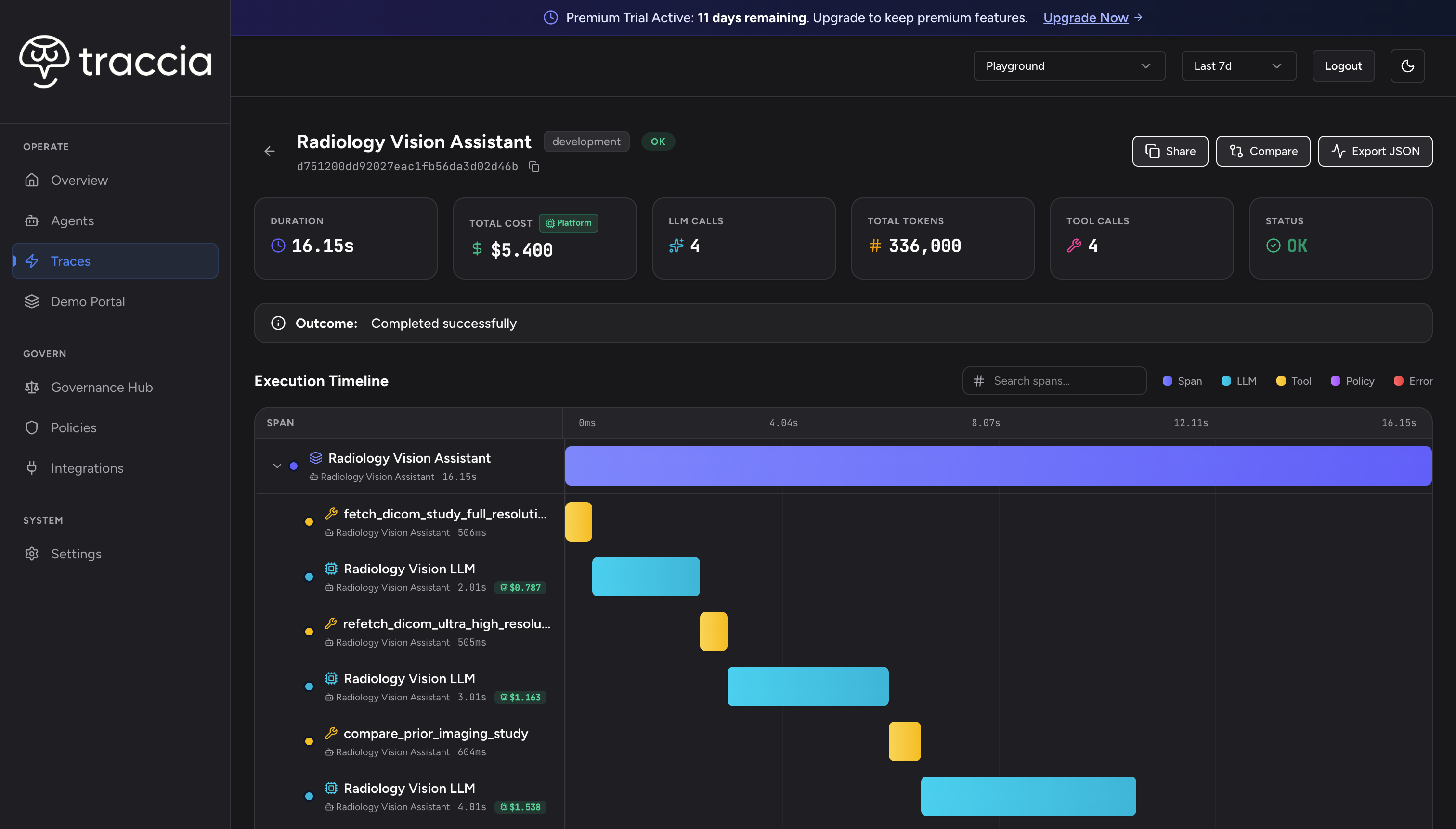
Intelligence: Cost as a Production Signal
Maxim surfaces cost and latency as part of production observability and optimization — useful alongside eval scores and simulation results.
Traccia’s Intelligence pillar is economic observability built for sampling realities:
- Token-level cost per agent and model
- Cost metrics that stay accurate when traces are sampled
- Historical recomputation across a 2,500+ model pricing registry
- Cost anomaly detection for spend that is not normal
Those signals power Control. Spend Cap policies and hard blocks need trustworthy cost data independent of trace sample rate.
Control: Two Enforcement Philosophies
Maxim: evaluate and alert on live traffic
Maxim emphasizes online evaluators and safety alerts — toxicity checks, responsible AI scorers, and regression alerts on production conversations. That is quality control on outputs and traffic patterns, not a hard gate before every agent invocation.
from maxim import Maxim  # illustrative
maxim = Maxim({"api_key": "..."})# Traces + online evaluators land in Maxim observability views
Traccia: policies + @govern at the agent boundary
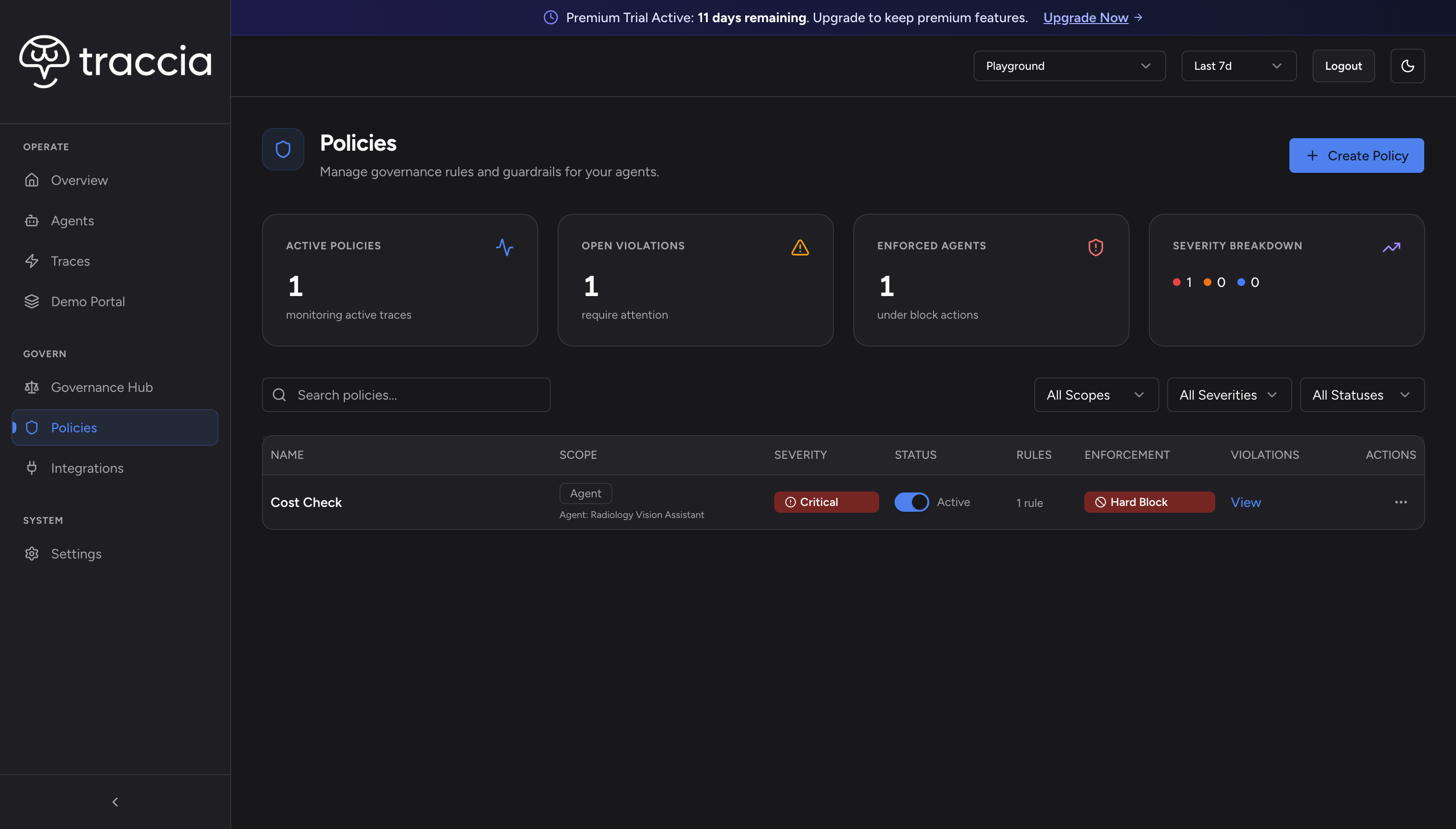
Traccia’s Control plane is embedded in the application path. Platform policies monitor Spend Cap, Retry Protection, Duration Limit, Token Limit, and Error Rate. @govern queries agent status before invocation; hard_block raises AgentBlockedError and the function body never executes. Soft blocks warn and continue.
from traccia import init, governfrom traccia.governance import AgentBlockedError
init(api_key="...", endpoint="https://api.traccia.ai/v2/traces")
@govern(agent_id="onboarding-agent", fail_open=False)def run_agent(user_msg: str) -> str:    return agent.run(user_msg)
Guardrail detection remains a supporting posture layer: classify Explicit / Provider-native / Heuristic signals and flag missing coverage. Detection proves controls existed; @govern enforces the next run.
Certification: Vendor Trust vs Trace Depth
Maxim’s SOC 2 / ISO 27001 / HIPAA / GDPR posture covers Maxim as a vendor. EU AI Act-style evidence from individual agent runs is not a primary product module.
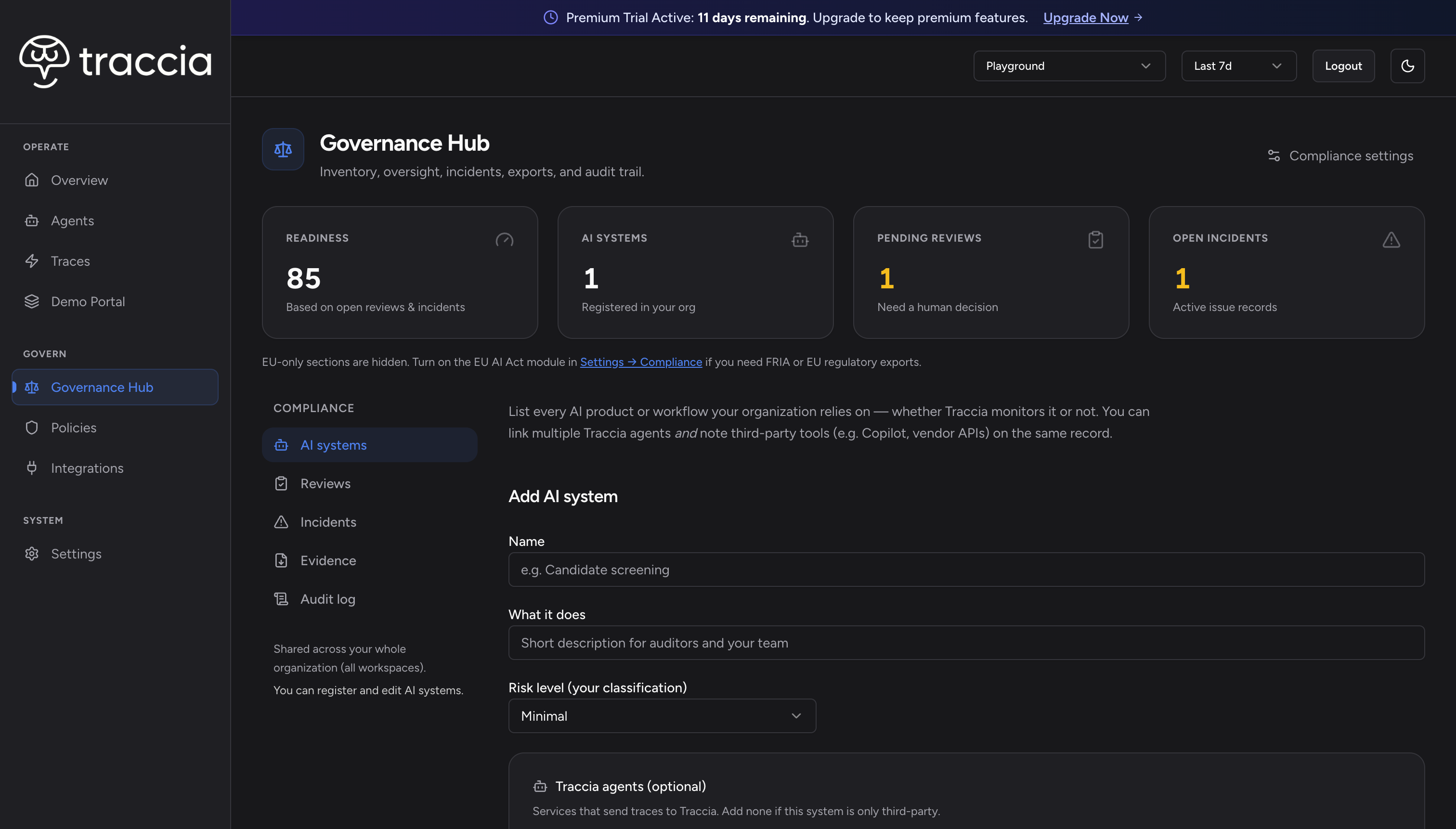
Traccia’s Certification pillar is depth on individual applications: governance enrichment on spans, FRIA draft wizard, disclosure() trails for transparency evidence, HIPAA compliance support, and article-mapped evidence packs exported from live telemetry.
| Capability | Maxim | Traccia |
|---|---|---|
| Production trace debugging | Visual multi-agent traces | Per-agent lineage + registry |
| Online safety evaluators | Native strength | Guardrail findings + policies |
| HIPAA compliance support | Vendor HIPAA posture / process | PHI inventory, safeguard checklists, HIPAA-labeled evidence exports |
| EU AI Act evidence from traces | Not a primary module | Integrity-hashed packs from OTel traces |
| FRIA drafts (Art. 27) | Not a primary module | Wizard → downloadable JSON |
| Governance Hub | Human eval pipelines | Registry, reviews, incidents, evidence export |
| Simulation / prompt IDE | Playground++, scenarios at scale | Roadmap |
These are complementary: Maxim for pre-prod quality and simulation; Traccia for agent-level enforce-and-prove on OpenTelemetry.
Where Maxim Leads
Maxim is the stronger choice when the bottleneck is quality confidence before and after ship.
- Large-scale agent simulation across thousands of scenarios
- Prompt IDE (Playground++) with versioning and no-code collaboration
- Rich evaluator library and human-in-the-loop eval pipelines
- Cross-functional UX for product and design teams
- Bifrost LLM gateway for routing needs
Where Traccia Leads
When you ship agents and need to observe, limit, and prove them in production, Traccia is the OpenTelemetry control plane.
- Developer-native Visibility with per-agent ops dashboards and lineage
- Sampling-accurate cost Intelligence that powers Spend Cap policies
- @govern hard blocks and platform policies at the agent boundary
- Versioned prompt management with Prompt Playground and SDK fetch at runtime
- Guardrail posture as evidence that controls fired on a run
- EU AI Act evidence packs, FRIA draft wizard, and HIPAA compliance support derived from the same OTel stream
- OpenTelemetry-first instrumentation without proprietary trace lock-in
Simulation is on Maxim’s home turf. Traccia’s differentiation is Control, Prompt Management, and Certification for production agents.
The Bottom Line
Choose Maxim if
Choose Maxim if you need to simulate, evaluate, and iterate on agent quality — including no-code collaboration and human review — across the development lifecycle.
Choose Traccia if
Choose Traccia if you need to enforce agent bounds in production: Visibility and cost Intelligence on OpenTelemetry, Control via policies and @govern, versioned prompt management, and Certification evidence (EU AI Act + HIPAA) from live traces.
References
- Traccia (https://traccia.ai)
- Traccia Docs: Policies (https://traccia.ai/docs/platform/policies)
- Maxim AI (https://www.getmaxim.ai)
See Traccia on your own agents
Instrument once with OpenTelemetry, then get agent-level tracing, sampling-accurate cost attribution, guardrail verification, and runtime policy enforcement — with a free tier to start.