Langfuse Alternative
Traccia vs Langfuse
Langfuse helps you debug and improve LLM apps. Traccia helps you observe agents, enforce policy at the agent boundary, and prove what happened. Enforce, not just observe.
Introduction
Most LLM tools stop at observation: show the trace, score the output, ship a better prompt. That is necessary, and it is where Langfuse shines. Production agent systems need something more: limits that actually stop runaway spend, proof that safety controls fired, and evidence an auditor can trust.
Traccia is built around a simple chain: Visibility → Intelligence → Control → Certification. You cannot govern what you cannot see. You cannot control what you do not understand. And you cannot certify what you do not control. The product philosophy is deliberate: enforce, not just observe.
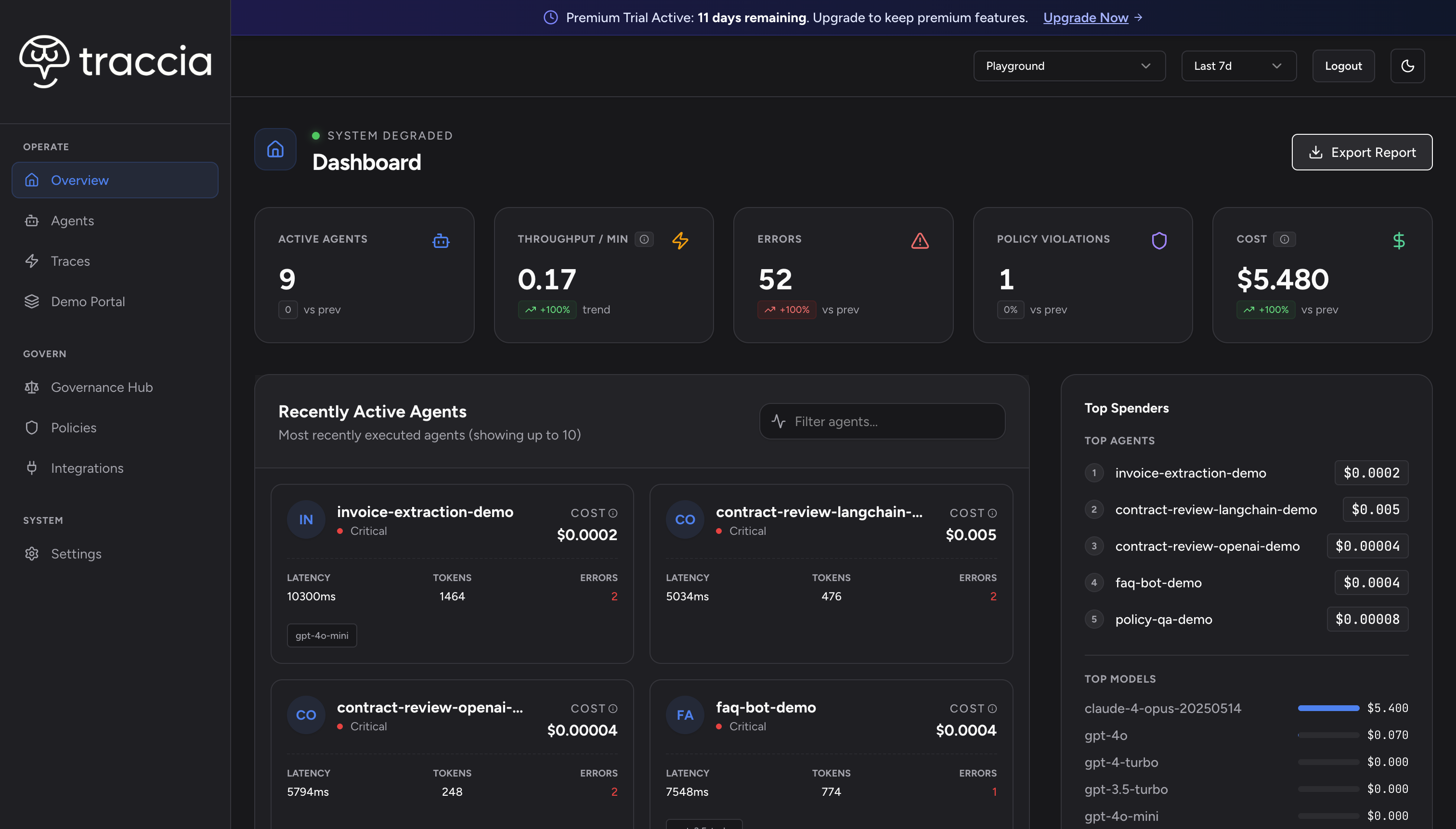
Langfuse is an open-source AI engineering platform for tracing, prompt management, evaluations, and experimentation, increasingly OpenTelemetry-native. Traccia is an OpenTelemetry-native observability and governance platform for agents: operational dashboards, sampling-accurate cost metrics, declarative policies, runtime gates via @govern, and telemetry-linked EU AI Act evidence.
At a Glance
A side-by-side view of how Langfuse and Traccia differ on the dimensions that matter for production AI systems.
| Dimension | Langfuse | Traccia | Edge |
|---|---|---|---|
| Core job | Debug, evaluate, and iterate on LLM apps | Observe, enforce, and certify agents in production | Different jobs |
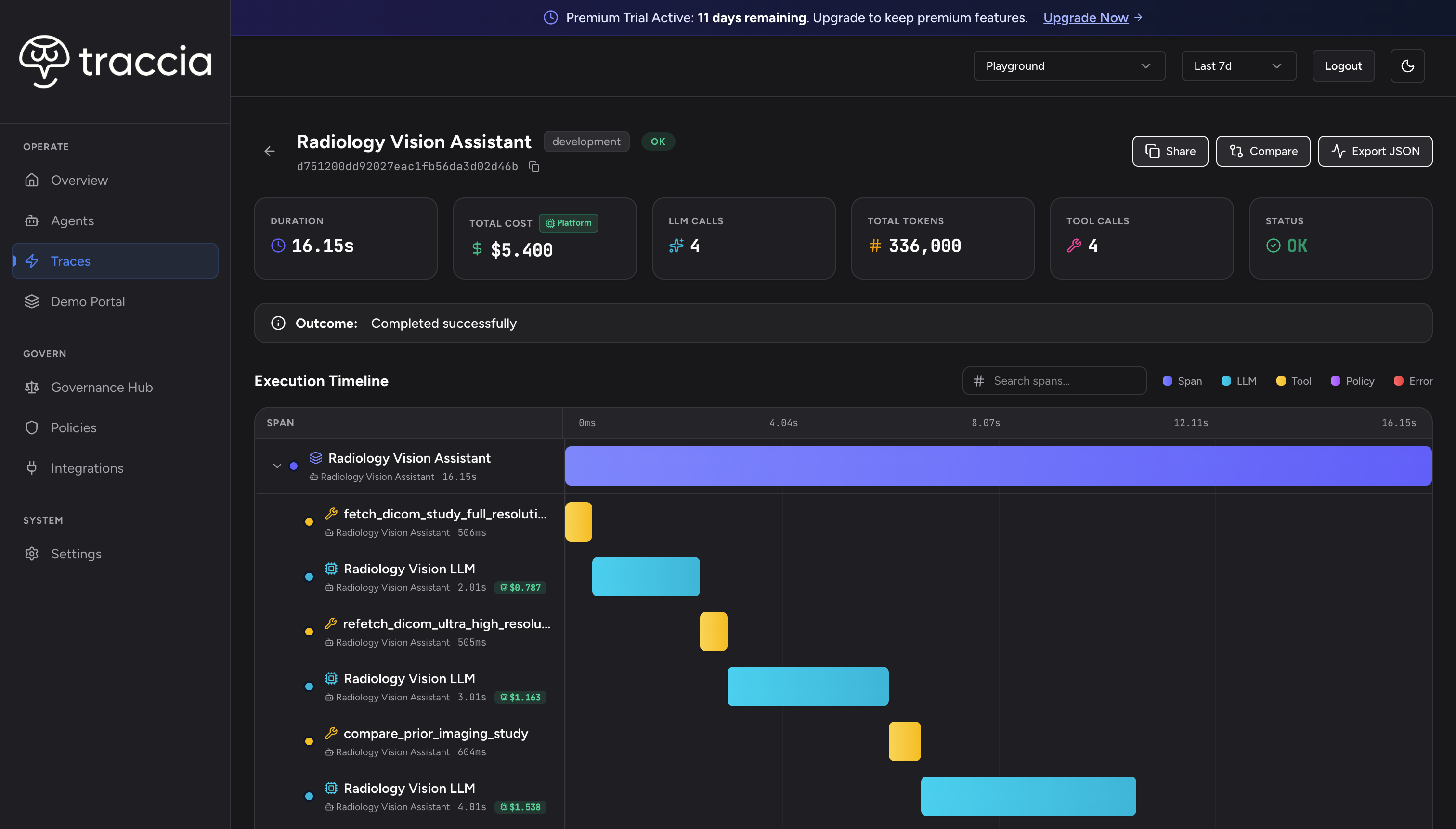
| Visibility | Traces, sessions, agent graphs | Per-agent tracing, decision lineage, tool calls | Parity |
| Intelligence (cost) | Cost estimation at write time | Sampling-accurate OTEL metrics + historical recomputation | Traccia |
| Policy enforcement | — | @govern + platform policies (spend, retries, limits) | Traccia |
| Guardrail posture | Observe external guardrail libraries | 3-tier detection; proves controls fired on a run | Traccia |
| Compliance evidence | Not a primary focus | EU AI Act module, FRIA drafts, HIPAA compliance support, evidence packs from traces | Traccia |
| Prompt management | Versioning, playground, deployments | Versioned prompts, Prompt Playground, SDK fetch | Parity |
| Evaluations & experiments | LLM-as-Judge, datasets, annotation queues | Roadmap | Langfuse |
| OpenTelemetry | OTel-native SDK + OTLP backend | OTel-first instrumentation + any OTLP backend | Parity |
| SDK languages | Python, TypeScript | Python, TypeScript | Parity |
| Deployment | Cloud or full self-host (MIT) | SDK open source; platform SaaS | Langfuse |
Visibility: What Happened?
Both platforms give you distributed traces for LLM and agent workflows. Langfuse adds sessions, user tracking, and rich agent graphs aimed at debugging. Traccia focuses on operating fleets of agents in production.
- Multi-step agent tracing with structured decision lineage
- Tool-invocation and workflow-level execution graphs
- Per-agent views for errors, latency, and throughput
- Import-time auto-instrumentation for OpenAI, Anthropic, LangChain, CrewAI, and OpenAI Agents SDK
- Standard OTLP export to Traccia Cloud or any collector (Tempo, Jaeger, SigNoz, Datadog)
from traccia import init, observe
init()  # Auto-instruments supported providers & frameworks
@observe(as_type="agent")def run_agent(prompt: str) -> str:    return call_llm(prompt)
Both Langfuse and Traccia now sit comfortably in an OpenTelemetry world. The difference is what you do with the spans once you have them. Langfuse optimizes the engineering loop; Traccia turns telemetry into control and certification.
Intelligence: What Did It Cost?
Langfuse estimates costs when traces are written, which is useful for day-to-day engineering. Traccia treats cost as economic observability: always-on signals finance and platform teams can trust.
- Token-level cost attribution per agent, workflow, and model
- Cost emitted as OpenTelemetry metrics independently of trace sampling (keep metrics at full rate while sampling traces to control storage)
- Platform recomputation across a 2,000+ model pricing registry when providers change prices, with org-level overrides
- Cost anomaly signals for spend that is not normal
That sampling split matters at scale. Sampling reduces trace volume; your bill does not. Metrics decoupled from sampling keep cost totals accurate. The Overview dashboard surfaces cost alongside Top Spenders by agent and model so finance and platform teams share the same signal.
Control: Enforce, Not Just Observe
This is the core philosophical gap. Langfuse helps you see and improve quality. Traccia is built to keep agents within bounds, and to stop them at the agent boundary when they are not.
Platform policies (the rules)
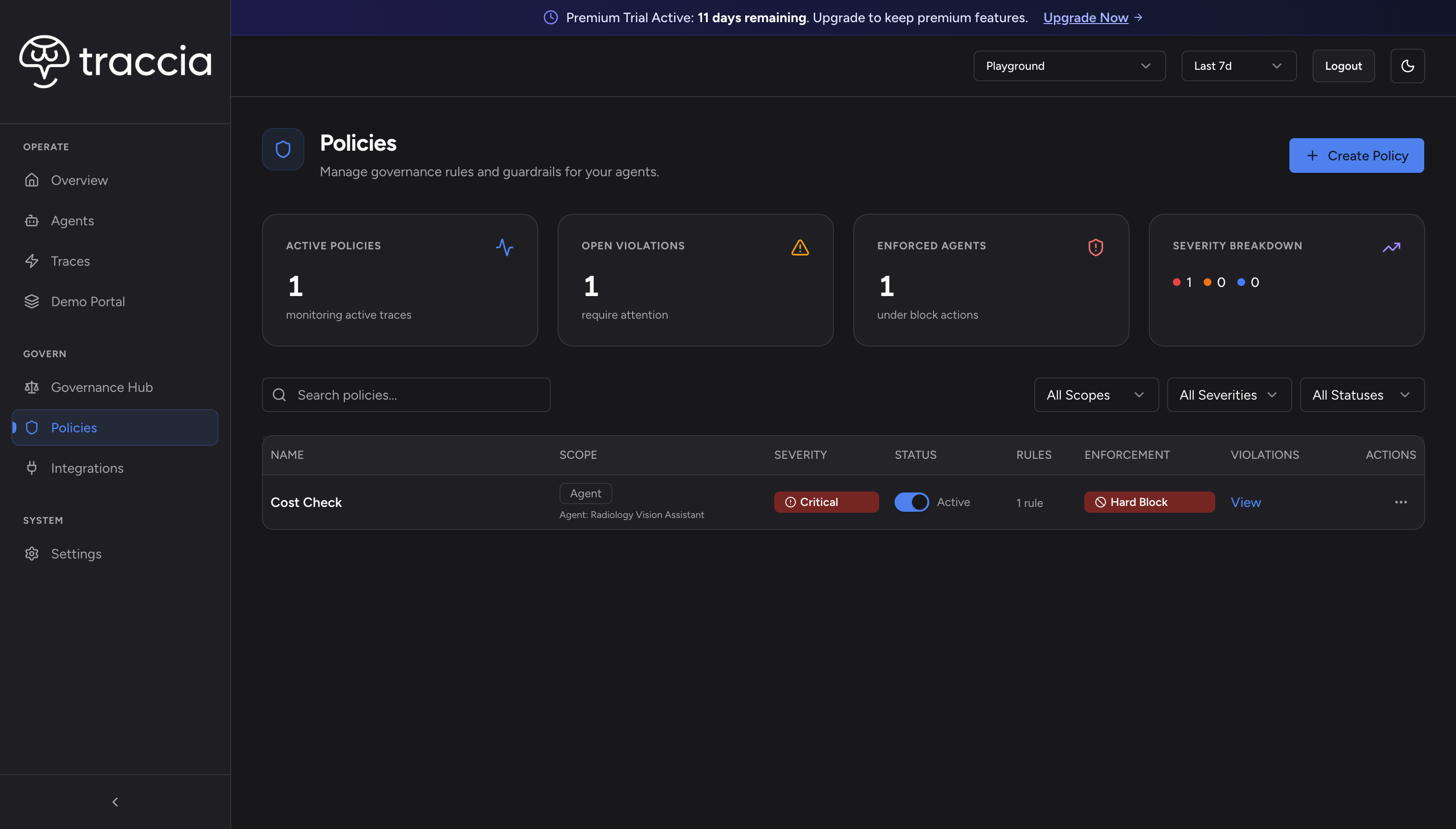
Declarative policies monitor agent behavior as traces land: Spend Cap, Retry Protection, Duration Limit, Token Limit, and Error Rate. Violations surface on the dashboard so teams know when agents exceed limits or loop.
Runtime policy enforcement (the gate)
Observability alone does not stop a runaway agent. Use @govern (or govern()) when you need the Traccia platform to check agent status before each invocation. If the platform has opened a hard_block violation, the decorated function never runs and AgentBlockedError terminates the call. Soft blocks warn and continue. This is enforcement at the agent boundary, not a post-hoc dashboard note.
from traccia import init, governfrom traccia.governance import AgentBlockedError
init(api_key="...", endpoint="https://api.traccia.ai/v2/traces")
@govern(agent_id="checkout-agent", fail_open=False)def run_checkout(prompt: str) -> str:    # Never enters when platform status is hard_block    return call_llm(prompt)
observe traces without a platform requirement. govern adds the runtime status check and requires Traccia Cloud. Full policy-enforcement packaging is available on Enterprise plans.
Guardrail posture (evidence that controls existed)
Separately, Traccia’s guardrail detection layer is passive: it classifies Explicit, Provider-native, and Heuristic safety signals on spans and flags missing coverage. It does not block traffic by itself. Think of it as certification fuel (proof that guardrails were present and fired), while @govern and policies are the control plane.
Certification: Can We Prove It?
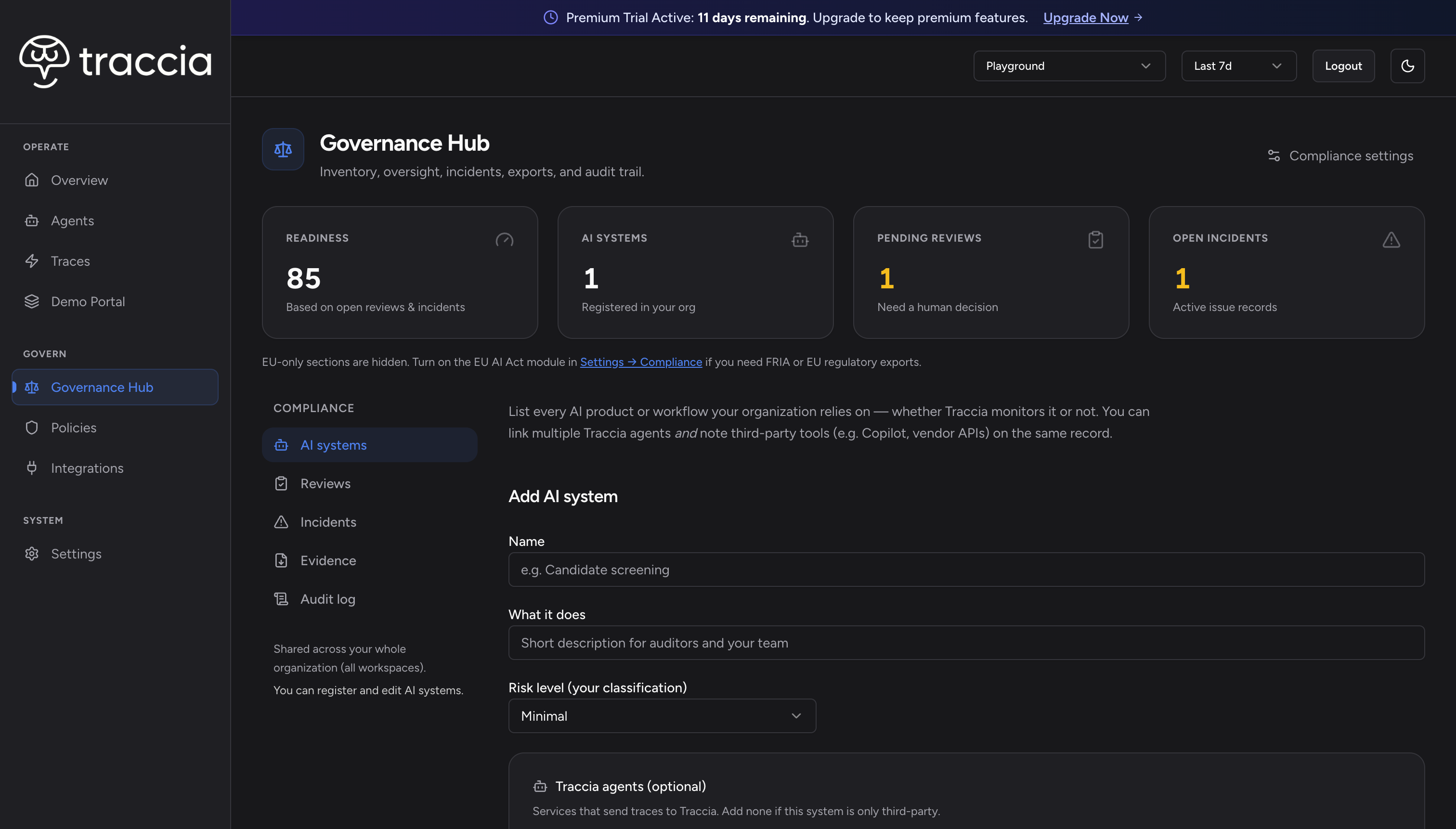
Langfuse is built for engineering workflows; regulatory evidence packs are not its primary surface. Traccia turns the same production telemetry into audit-oriented outputs:
| Capability | Langfuse | Traccia |
|---|---|---|
| EU AI Act evidence from traces | Not a primary focus | Article mapping + exportable evidence packs |
| HIPAA compliance support | Vendor HIPAA posture / process | PHI inventory, safeguard checklists, HIPAA-labeled evidence exports |
| FRIA (Art. 27) drafts | Not a primary focus | Wizard → downloadable JSON (not a filing) |
| Transparency disclosures | Not a primary focus | disclosure() for Art. 50 evidence trails |
| Integrity / audit trails | Platform audit features (cloud) | Integrity-hashed governance exports |
| Guardrail posture on runs | External libs you instrument yourself | 3-tier detection + missing-guardrail flags |
Honest scope: Traccia helps collect and organize evidence. It does not classify your system’s risk tier for you, perform conformity assessment, or file with authorities.
Where Langfuse Leads
If your primary job is improving model quality and shipping better prompts, Langfuse remains one of the strongest open-source choices.
- Prompt management with versioning, playground, caching, and one-click deploy/rollback
- Evaluation engine: LLM-as-Judge, code evaluators, datasets, experiments, and annotation queues
- Mature self-hosting (Docker, Kubernetes, Terraform) with MIT-licensed core
- Broad integration ecosystem and an OTel-native path that fits existing observability stacks
- A large OSS community optimized for the AI engineering workflow
Where Traccia Leads
When the job is operating agents in production under real limits and audit pressure, Traccia is built for that path.
- Enforce, not just observe: platform policies plus @govern hard blocks at the agent boundary
- Sampling-accurate cost intelligence via OpenTelemetry metrics, with historical recomputation
- Versioned prompt management with Prompt Playground and SDK fetch at runtime
- Guardrail posture that proves controls fired on a run (separate from enforcement)
- EU AI Act evidence packs, FRIA drafts, and HIPAA compliance support derived from live traces
- OpenTelemetry-first instrumentation that exports to Traccia or any OTLP backend
Outcome evaluation and datasets are on Traccia’s roadmap. Today the edge is Control, Prompt Management, and Certification on top of solid Visibility and cost Intelligence.
The Bottom Line
Choose Langfuse if
Choose Langfuse if you need a best-in-class AI engineering loop: prompts, evals, experiments, and self-hosted observability for debugging LLM quality.
Choose Traccia if
Choose Traccia if you need to enforce, not just observe: OpenTelemetry-native agent visibility, sampling-accurate cost intelligence, platform policies and @govern hard blocks, versioned prompt management, plus certification evidence (EU AI Act + HIPAA) from live traces.
References
- Traccia (https://traccia.ai)
- Traccia Docs: observe vs govern (https://traccia.ai/docs/sdk/governance)
- Langfuse (https://langfuse.com)
- Langfuse Docs (https://langfuse.com/docs)
See Traccia on your own agents
Instrument once with OpenTelemetry, then get agent-level tracing, sampling-accurate cost attribution, guardrail verification, and runtime policy enforcement — with a free tier to start.