Credo AI Alternative
Traccia vs Credo AI
Credo AI governs the organization. Traccia governs the production agent with Visibility, Intelligence, Control, and Certification from live OpenTelemetry.
Introduction
Credo AI created much of the modern AI governance category: policy packs for EU AI Act, NIST AI RMF, ISO 42001, and SOC 2; AI registries; vendor risk; executive reporting. It is the system of record for how an organization intends to govern AI. In enterprise language this sits in GRC (governance, risk, and compliance): the people, policies, and processes that keep AI programs accountable across the company.
Traccia answers a different question: what did this agent actually do, cost, and get blocked from doing in production? Visibility → Intelligence → Control → Certification, from OpenTelemetry spans, not only from questionnaires. The two layers often work together. Credo AI sets organizational policy; Traccia enforces and proves runtime behavior.
At a Glance
A side-by-side view of how Credo AI and Traccia differ on the dimensions that matter for production AI systems.
| Dimension | Credo AI | Traccia | Edge |
|---|---|---|---|
| Layer of the stack | Enterprise GRC / AI system of record | Runtime observability + agent control plane | Complementary |
| Primary user | GRC, risk, compliance, executives | Platform, ML, and compliance-minded engineers | Different buyers |
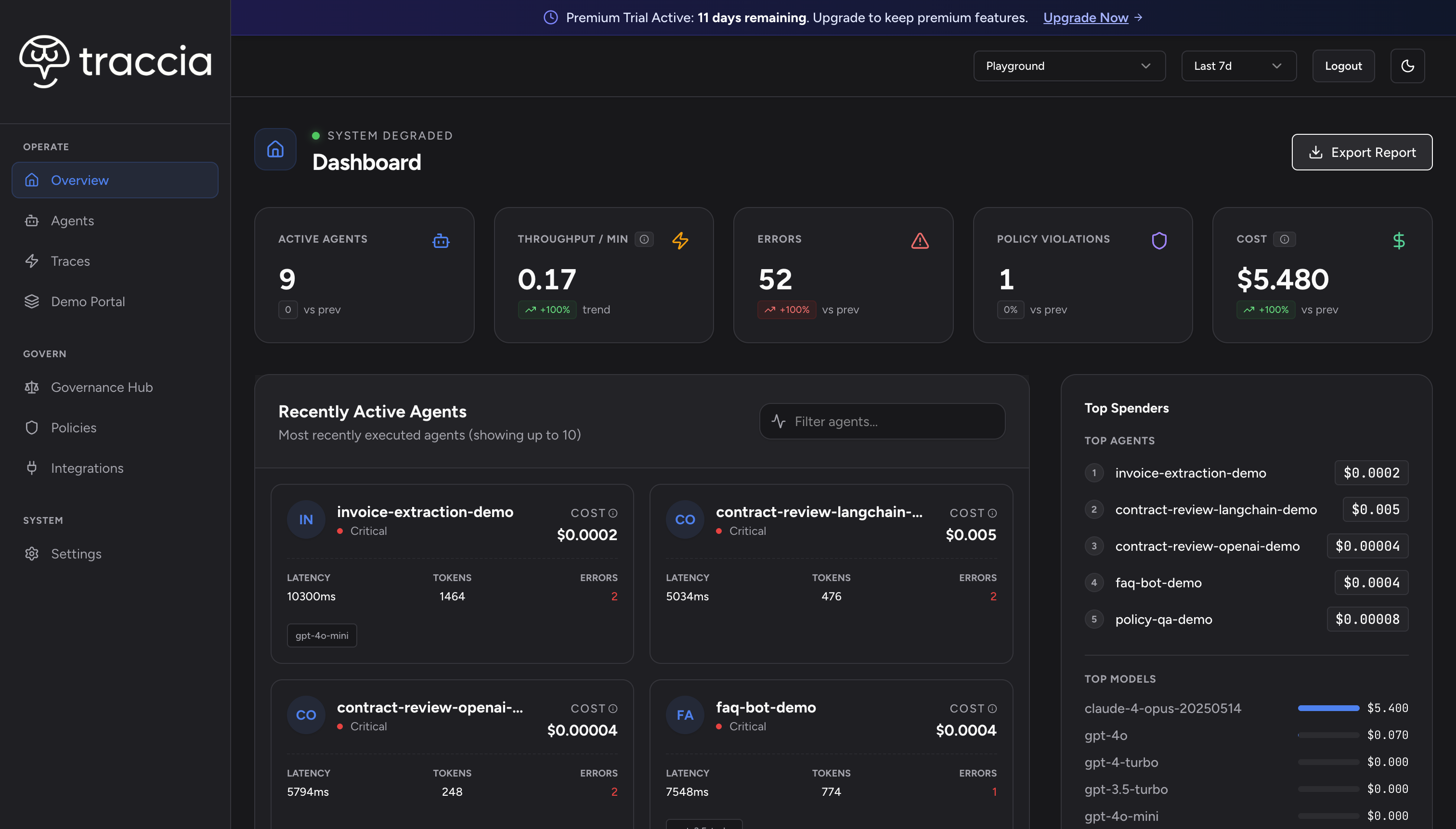
| Visibility (runtime) | Inventory & monitoring integrations | OTel agent tracing, lineage, tool calls | Traccia |
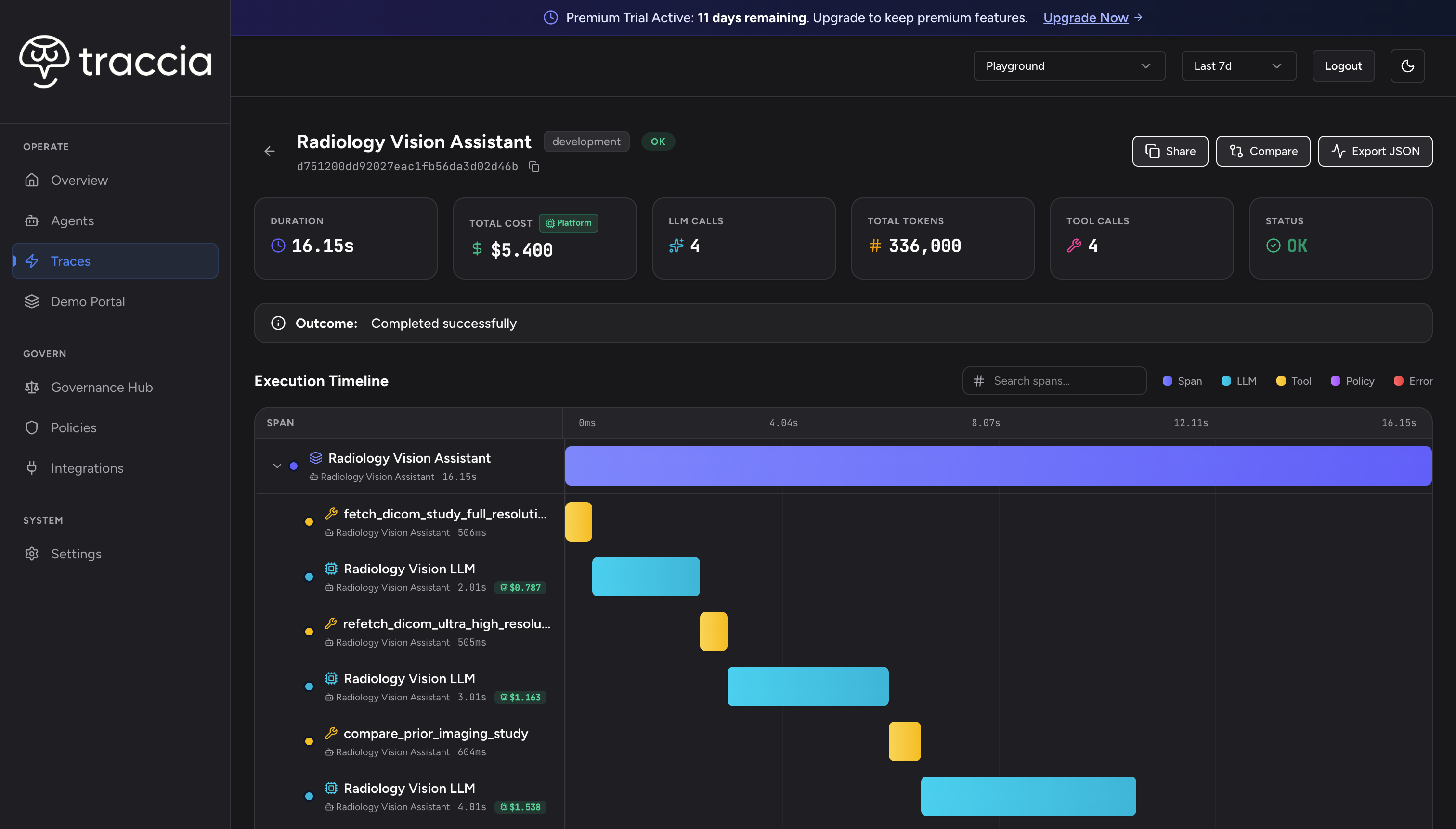
| Intelligence (cost) | — | Sampling-accurate cost attribution (2,000+ models) | Traccia |
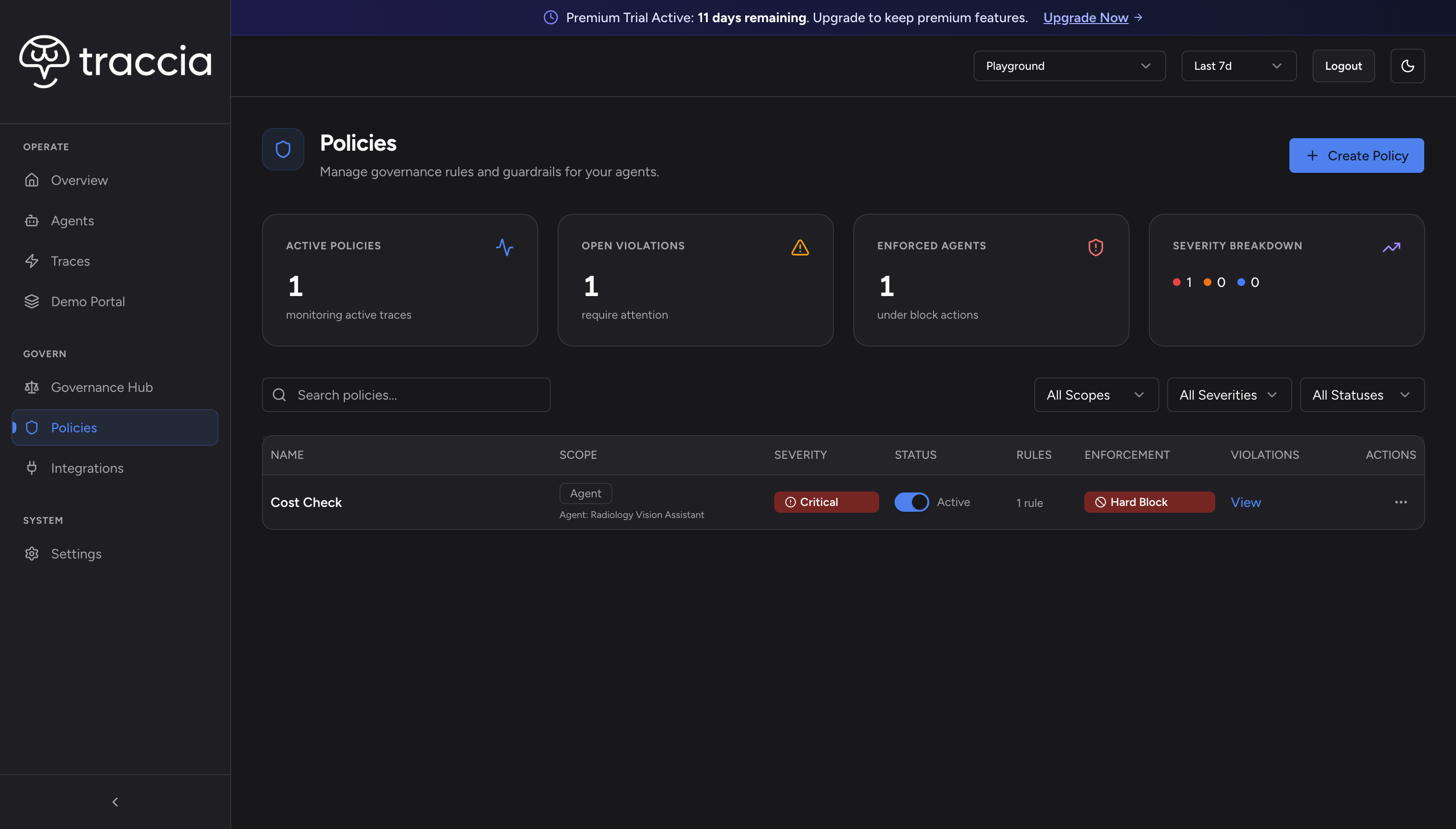
| Org policy packs | EU AI Act, NIST, ISO 42001, SOC 2 packs | Runtime spend/retry/duration/token/error policies | Credo AI |
| Agent enforcement | Governance workflows; runtime depth varies | @govern hard_block at the agent boundary | Traccia |
| Evidence source | Assessments, questionnaires, policy packs | Evidence packs from actual traces | Different proof |
| Prompt management | — | Versioned prompts, Prompt Playground, SDK fetch | Traccia |
| Vendor / Shadow AI | Vendor assessments + discovery | Roadmap | Credo AI |
| SDK instrumentation | API automation SDK | Python & TypeScript auto-instrumentation | Traccia |
Visibility: Runtime Depth vs Portfolio Breadth
Both platforms can answer “what AI systems do we have?” Credo AI does it as an enterprise registry with discovery and GRC workflows across the portfolio. Traccia does it as an AI system inventory linked to live traces, plus OpenTelemetry observability for each agent run.
- Per-agent tracing with error, latency, and throughput dashboards
- Decision lineage and tool-call visibility across multi-step workflows
- Auto-instrumentation across major LLM providers and agent frameworks
- OTLP export to Traccia Cloud or your existing collector
- System registry with trace links for the applications you instrument
Where they diverge is depth versus breadth. Credo AI is stronger at organization-wide inventory, vendor risk, and multi-framework GRC process. Traccia is stronger when you need to see, measure, and control what a specific agent did on a specific run.
Intelligence: Economic Observability
Spend transparency is rarely a GRC platform’s job. Traccia makes cost a first-class signal:
- Token-level cost per agent, workflow, and model
- OTEL cost metrics independent of trace sampling
- Historical recomputation when provider prices change (2,000+ model registry)
- Anomaly signals when spend is not normal
That Intelligence layer feeds Control: Spend Cap policies and @govern gates need accurate cost signals to be meaningful.
Control: Organizational Policy vs Agent Enforcement
Credo AI: policy packs and workflows
Credo AI translates regulations into actionable policy packs and governance workflows: risk registers, assessments, vendor portals, and audit-ready checklists. That is how enterprises operationalize NIST, ISO 42001, and the EU AI Act at the portfolio level.
Traccia: enforce at the agent boundary
Traccia’s Control plane is code-adjacent. Platform policies (Spend Cap, Retry Protection, Duration Limit, Token Limit, Error Rate) flag violations as telemetry arrives. @govern checks agent status before each invocation; hard_block means the function body never runs. That is enforce, not just observe.
from traccia import init, governfrom traccia.governance import AgentBlockedError
init(api_key="...", endpoint="https://api.traccia.ai/v2/traces")
@govern(agent_id="claims-agent", fail_open=False)def handle_claim(payload: dict) -> str:    return run_workflow(payload)
Guardrail detection sits underneath as posture evidence, proving Explicit / Provider-native controls fired, without pretending detection alone is enforcement.
Certification: Organizational Records vs Trace Evidence
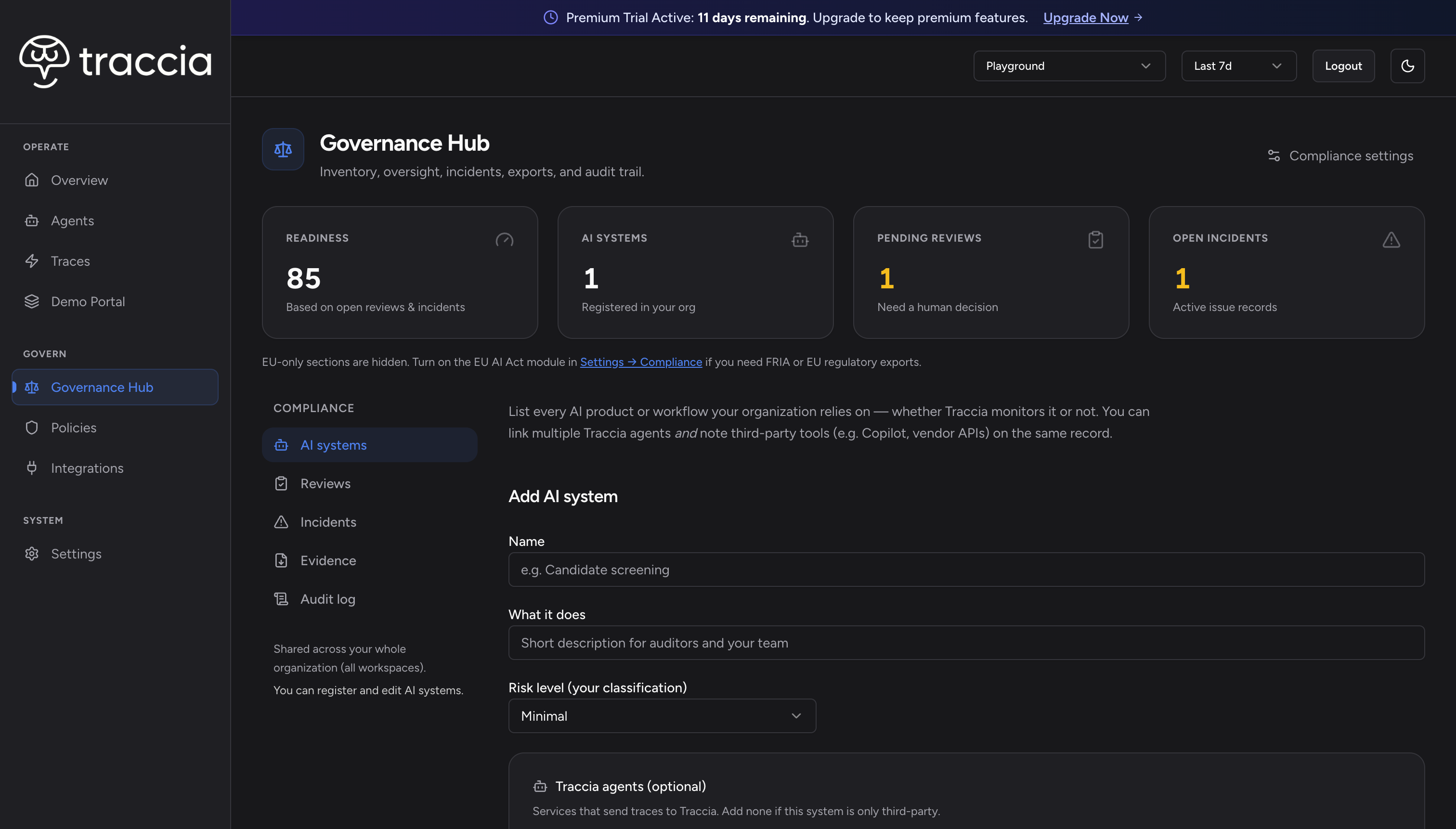
Both platforms care about EU AI Act readiness and compliance. The proof looks different:
| Capability | Credo AI | Traccia |
|---|---|---|
| Multi-framework policy packs | EU AI Act, NIST, ISO 42001, SOC 2, … | EU-focused module; broader packs on roadmap |
| HIPAA compliance support | Vendor HIPAA posture / GRC checklists | PHI inventory, safeguard checklists, HIPAA-labeled evidence exports |
| FRIA / impact assessments | Structured GRC workflows & templates | Art. 27 wizard → downloadable JSON draft |
| Evidence source | Assessments, questionnaires, control mapping | Timestamped traces + integrity-hashed exports |
| Vendor risk | Dedicated vendor assessment flows | Roadmap |
An auditor asking “were spend limits and guardrails active on March 15?” can get organizational status from a GRC tool, and span-level proof from Traccia. Many regulated teams will want both.
Where Credo AI Leads
Credo AI is the better fit when the buyer is GRC and the artifact is organizational compliance.
- Pre-built policy packs spanning EU AI Act, NIST AI RMF, ISO 42001, SOC 2, and more
- AI registry, shadow discovery, and vendor risk assessment workflows at portfolio scale
- Executive dashboards and cross-functional governance process
- Forward-deployed expertise and regulatory intelligence across the enterprise AI estate
Where Traccia Leads
When you need to enforce and prove what production agents did, Traccia is the runtime layer.
- OpenTelemetry-native Visibility for each agent run, with a system registry linked to traces
- Sampling-accurate cost Intelligence that feeds Spend Cap and FinOps workflows
- @govern hard blocks and platform policies at the agent boundary
- Versioned prompt management with Prompt Playground and SDK fetch at runtime
- Guardrail posture that proves controls fired on a run
- EU AI Act evidence packs, FRIA draft wizard, and HIPAA compliance support derived from live telemetry
Traccia does not replace Credo AI’s organizational GRC layer. It supplies the runtime Visibility, cost Intelligence, agent Control, and telemetry Certification that questionnaires cannot invent.
The Bottom Line
Choose Credo AI if
Choose Credo AI if you need top-down AI governance: multi-framework policy packs, vendor assessments, and an enterprise system of record for GRC teams.
Choose Traccia if
Choose Traccia if you need to enforce and prove agent behavior in production: OpenTelemetry visibility, cost intelligence, @govern policy gates, versioned prompt management, and compliance evidence packs (EU AI Act + HIPAA) from live traces. Pair it with Credo AI when you need both layers.
References
- Traccia (https://traccia.ai)
- Traccia Docs: Governance (https://traccia.ai/docs/sdk/governance)
- Credo AI (https://credo.ai)
- Credo AI Product (https://www.credo.ai/product)
See Traccia on your own agents
Instrument once with OpenTelemetry, then get agent-level tracing, sampling-accurate cost attribution, guardrail verification, and runtime policy enforcement — with a free tier to start.