Azure AI Foundry Alternative
Traccia vs Azure AI Foundry
Azure AI Foundry manages model lifecycles, prompt engineering, and evaluations in a unified cloud platform. Traccia governs the running agent with Visibility, Intelligence, Control, and Certification on OpenTelemetry.
Introduction
Azure AI Foundry (formerly Azure AI Studio) is Microsoft's unified platform-as-a-service for enterprise AI operations. It consolidates model deployment, agent hosting, prompt engineering playgrounds, built-in evaluations, and content safety filters under a single Azure resource with enterprise-grade networking, RBAC, and Azure Policy integration. It gives teams access to over 1,900 models from OpenAI, Anthropic, Mistral, Meta, DeepSeek, and others, along with Foundry Agent Service for hosting and scaling agentic applications.
Traccia is the developer runtime control plane. Philosophy: Visibility, Intelligence, Control, Certification. Enforce, not just observe. Instrument once with OpenTelemetry, attribute cost accurately under sampling, define operational policies, gate agents with @govern, and export evidence from the same spans, without becoming a model lifecycle platform.
At a Glance
A side-by-side view of how Azure AI Foundry and Traccia differ on the dimensions that matter for production AI systems.
| Dimension | Azure AI Foundry | Traccia | Edge |
|---|---|---|---|
| Layer of the stack | Cloud-native model lifecycle and agent hosting platform | Runtime agent observability and control plane | Different jobs |
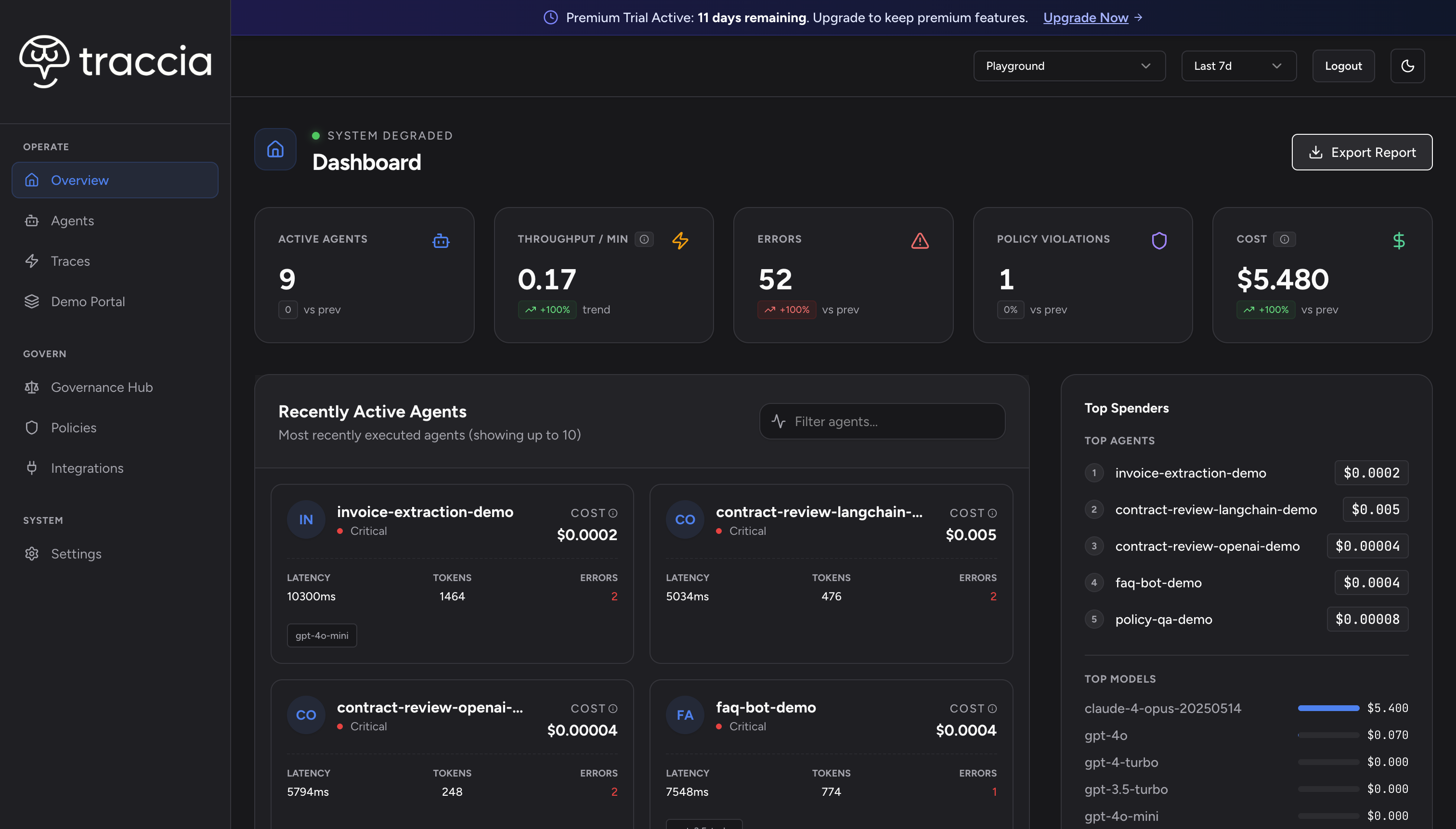
| Visibility | OpenTelemetry via Azure Monitor and Application Insights | OTel tracing, lineage, per-agent ops dashboards | Different approach |
| Intelligence (cost) | Subscription-level Azure billing and token metrics | Sampling-accurate cost + anomaly detection | Traccia |
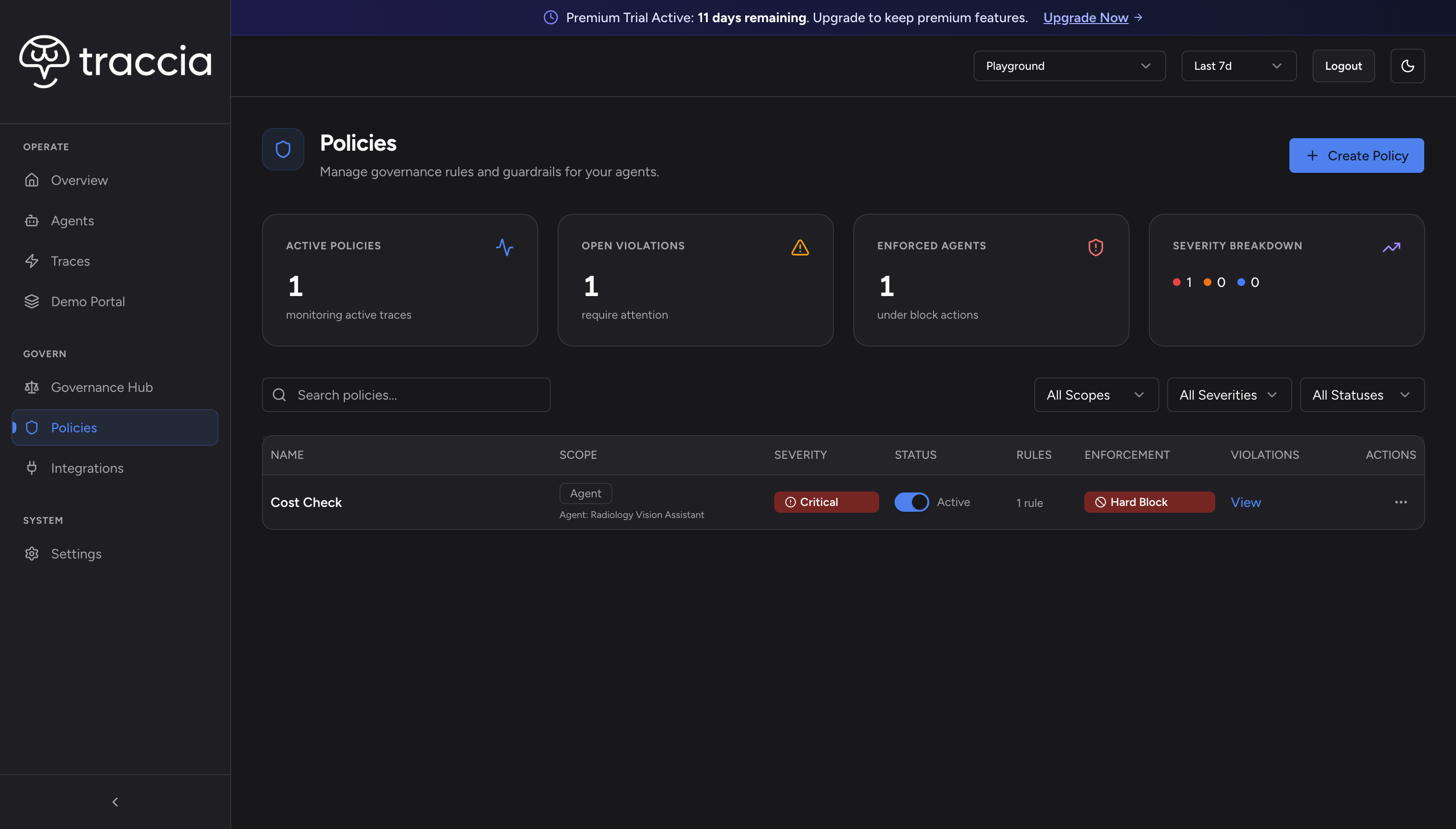
| Agent-boundary control | Content Safety filters + Azure Policy at resource level | @govern + platform policies (spend, retries, limits) | Different approach |
| Model catalog and deployment | 1,900+ models with managed hosting and fine-tuning | — | Azure AI Foundry |
| Prompt engineering | Prompt Flow, playgrounds, model comparison | Versioned prompts, Prompt Playground, SDK fetch | Different approach |
| Evaluations | Built-in model-assisted and mathematical evaluators | Roadmap | Azure AI Foundry |
| Content safety | Azure Content Safety API (text, image, video) | 3-tier guardrail detection engine | Different approach |
| Evidence from live traces | Diagnostic logs and Application Insights workspaces | Article-mapped evidence packs from OTel spans | Traccia |
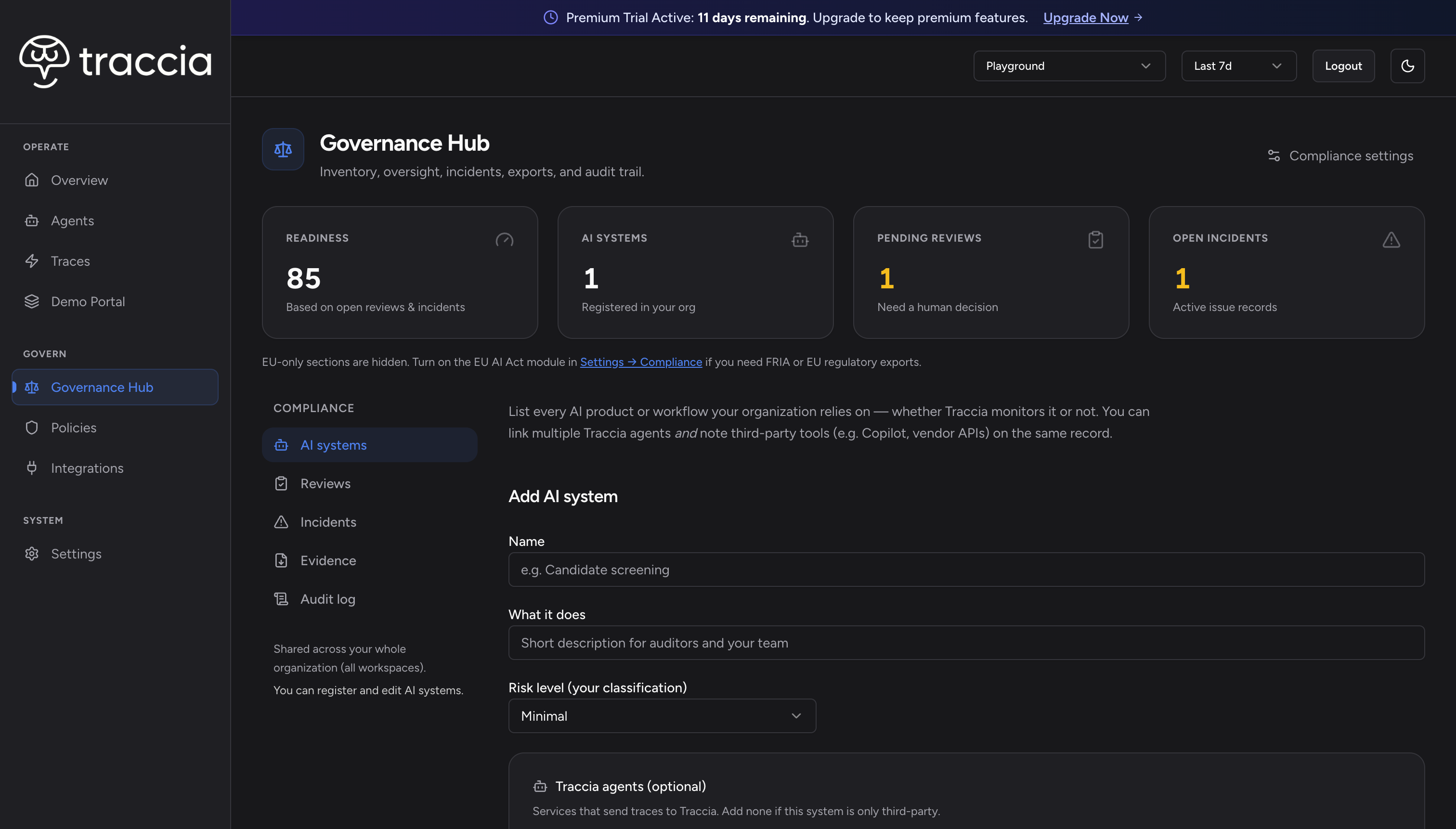
| Regulatory compliance mapping | — | EU AI Act module, FRIA wizard, disclosure API, HIPAA compliance support | Traccia |
| Developer SDK | Python, C#, JavaScript, Java | Python and TypeScript OTel auto-instrumentation | Azure AI Foundry |
Visibility: Cloud-Managed Telemetry vs Agent-Native Tracing
Azure AI Foundry's Visibility strength is integrated platform telemetry: traces flow from the Foundry SDK through OpenTelemetry into Application Insights and Azure Monitor. Developers enable tracing by configuring a tracer provider and exporter, then view end-to-end spans covering agent operations, model calls, and tool invocations. The setup requires explicit provider initialization and exporter wiring.
from opentelemetry import tracefrom opentelemetry.sdk.trace import TracerProviderfrom opentelemetry.sdk.trace.export import BatchSpanProcessorfrom azure.monitor.opentelemetry.exporter import AzureMonitorTraceExporter
provider = TracerProvider()trace.set_tracer_provider(provider)exporter = AzureMonitorTraceExporter(    connection_string=os.getenv("APPLICATIONINSIGHTS_CONNECTION_STRING"))provider.add_span_processor(BatchSpanProcessor(exporter))
with trace.get_tracer("agent-logger").start_as_current_span("agent_run") as span:    span.set_attribute("agent.type", "recommender")
Traccia's Visibility strength is operational and zero-config:
- Per-agent tracing with errors, latency, and throughput
- Multi-step decision lineage and tool-call graphs
- Import-time auto-instrumentation for major LLM stacks
- W3C OTLP to Traccia Cloud or any OpenTelemetry backend
from traccia import init, observe
init()
@observe(as_type="agent")def run(prompt: str) -> str:    return call_llm(prompt)
Azure AI Foundry traces are tightly coupled to Application Insights and Azure Monitor. Traccia traces are portable W3C OTLP, exportable to Jaeger, Grafana, Datadog, or Traccia Cloud without vendor lock-in.
Intelligence: Cost as a Production Signal
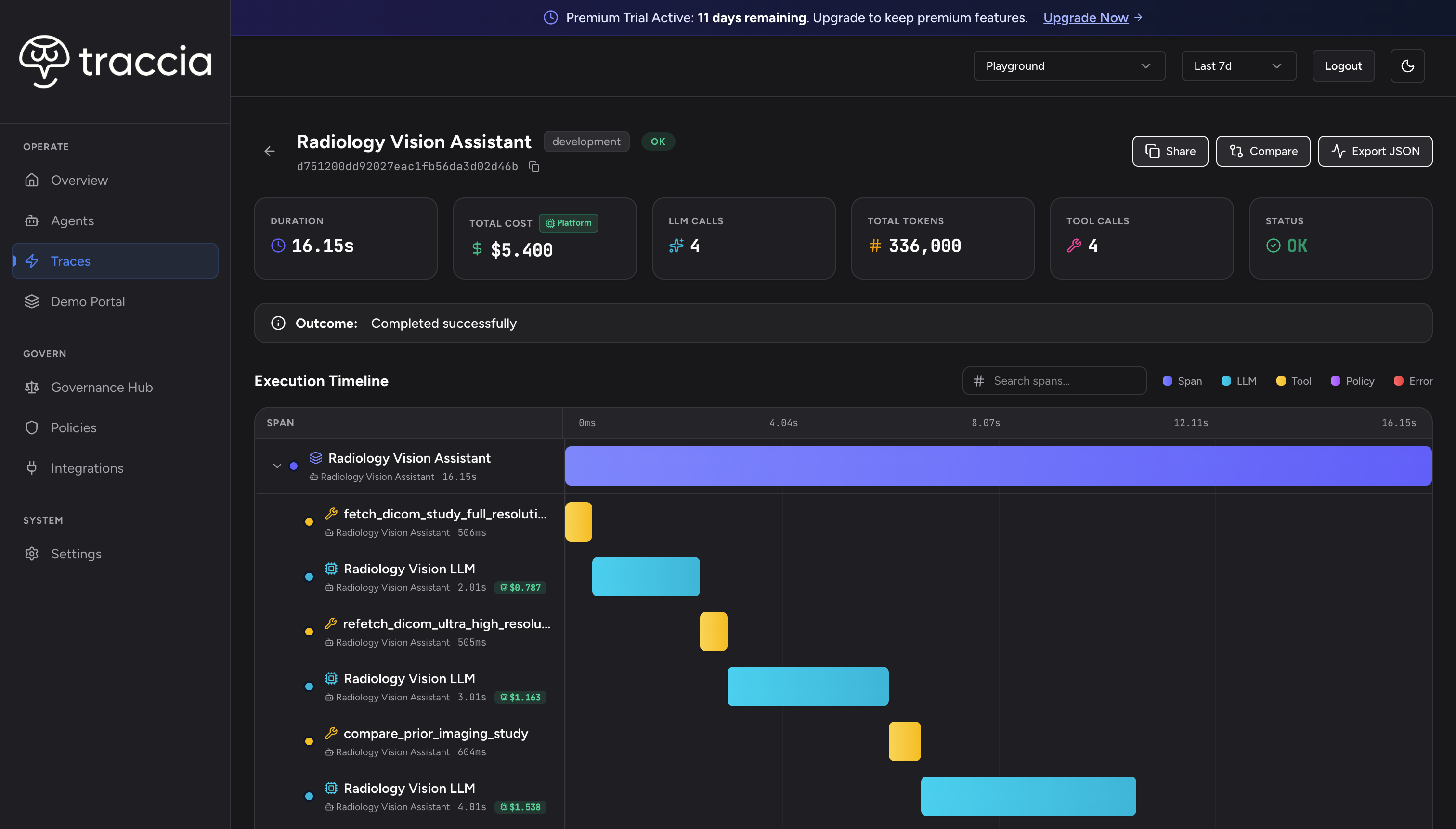
Azure AI Foundry tracks token usage as span attributes and surfaces billing through the Azure Portal at the subscription level. Azure Cost Management provides aggregate spend views, but cost data is not embedded in the developer SDK at span time and does not support retroactive recomputation when provider pricing changes.
Traccia's Intelligence pillar is economic observability:
- Token-level cost per agent and model
- Cost metrics that stay accurate when traces are sampled
- Historical recomputation across a 2,500+ model pricing registry
- Cost anomaly detection for spend that is not normal
Those signals power Control. Spend Cap policies and hard blocks need trustworthy cost data.
Control: Two Enforcement Philosophies
Azure AI Foundry: platform-level safety and policy
Azure AI Foundry manages safety through Azure Content Safety filters and Azure Policy. The Content Safety API screens text, images, and video for violence, hate speech, sexual content, and self-harm. Guardrails in the playground protect against jailbreaks and prompt injections. Azure Policy enforces resource-level governance (networking, RBAC, deployment configuration), and Entra ID controls identity and access.
These controls operate at the cloud infrastructure layer. They do not provide code-level, pre-invocation gates that halt individual agent function calls based on operational metrics like spend, error rate, or token limits.
Traccia: policies + @govern at the agent boundary
Traccia's Control plane is embedded in the application path. Platform policies monitor Spend Cap, Retry Protection, Duration Limit, Token Limit, and Error Rate. @govern queries agent status before invocation; hard_block raises AgentBlockedError and the function body never executes. Soft blocks warn and continue.
from traccia import init, governfrom traccia.governance import AgentBlockedError
init(api_key="...", endpoint="https://api.traccia.ai/v2/traces")
@govern(agent_id="underwriting-agent", fail_open=False)def decide(application: dict) -> str:    return run_underwriting(application)
Guardrail detection remains a supporting posture layer: classify Explicit / Provider-native / Heuristic signals and flag missing coverage. Detection proves controls existed; @govern enforces the next run.
Certification: Cloud Policy Governance vs Trace Depth
Azure AI Foundry inherits Azure's enterprise compliance certifications (SOC 2, HIPAA, ISO 27001, FedRAMP) and enforces organizational governance through Azure Policy and Entra ID RBAC. Resources are configured with compliant security settings, and access to models is restricted via managed identities. These are infrastructure-layer certifications.
Traccia's Certification pillar is depth on individual applications: governance enrichment on spans, FRIA draft wizard, disclosure() trails for transparency evidence, HIPAA compliance support, and article-mapped evidence packs exported from live telemetry.
Governance and Compliance Parity
| Capability | Azure AI Foundry | Traccia |
|---|---|---|
| Cloud compliance certifications | SOC 2, HIPAA, ISO 27001, FedRAMP via Azure | — |
| Resource-level governance | Centralized management via Azure Policy | — |
| Identity and access control | Entra ID, managed identities, Azure RBAC | API keys + client-scoped roles |
| Content safety filters | Azure Content Safety (text, image, video) | Integration-layer guardrail detection |
| Evidence from production spans | Diagnostic logs and workspaces | Integrity-hashed evidence packs from OTel traces |
| Regulatory trace mapping | — | Article-mapped compliance exports (EU AI Act), and HIPAA compliance support |
On EU AI Act mapping specifically: Azure AI Foundry does not provide regulatory compliance mapping as a product capability. Its documentation references the EU AI Act in two places, and both are disclaimers rather than tooling: its agent-guardrail "prohibited actions taxonomy" states explicitly that it is illustrative only, does not reflect Microsoft policy or regulatory interpretation, and leaves customers "solely responsible" for their own compliance; and its Enterprise AI Services Code of Conduct says only that it was "designed to better align with emerging AI regulations (e.g., EU AI Act)," a contractual usage policy, not an article-mapped compliance or evidence-generation feature. This confirms the Certification table entry: Azure offers cloud infrastructure certifications (SOC 2, HIPAA, ISO 27001, FedRAMP) plus a legal disclaimer pointing customers to their own counsel, whereas Traccia generates article-mapped EU AI Act evidence packs directly from live agent telemetry.
These are complementary: Azure AI Foundry for cloud infrastructure governance and model lifecycle management; Traccia for agent-level enforce-and-prove on OpenTelemetry.
Where Azure AI Foundry Leads
Azure AI Foundry is the stronger choice when the buyer needs a full model lifecycle platform inside the Azure ecosystem.
- Model catalog with 1,900+ models from OpenAI, Anthropic, Mistral, Meta, DeepSeek, and Hugging Face, with managed hosting and fine-tuning
- Foundry Agent Service for containerized, auto-scaling agent deployments with dedicated Entra identity
- Prompt Flow and playground for visual prompt engineering, model comparison, and parameter tuning
- Built-in evaluations with model-assisted and mathematical metrics for groundedness, relevance, coherence, and safety
- Enterprise control plane with Entra ID, Azure Resource Manager, Virtual Networks, and Azure Policy
- Content Safety API for real-time text, image, and video filtering
- Multi-language SDK support across Python, C#, JavaScript, and Java
Where Traccia Leads
When you ship agents and need to observe, limit, and prove them in production, Traccia is the OpenTelemetry control plane.
- Developer-native Visibility with per-agent ops dashboards and lineage
- Sampling-accurate cost Intelligence that powers Spend Cap policies
- @govern hard blocks and platform policies at the agent boundary
- Versioned prompt management with Prompt Playground and SDK fetch at runtime
- Guardrail posture as evidence that controls fired on a run
- EU AI Act evidence packs, FRIA draft wizard, and HIPAA compliance support derived from the same OTel stream
Traccia does not try to be a model lifecycle platform. It is the runtime layer for the agents you ship.
The Bottom Line
Choose Azure AI Foundry if
Choose Azure AI Foundry if you need a managed model lifecycle platform: model catalog, agent hosting, prompt engineering, evaluations, and enterprise cloud governance inside the Azure ecosystem.
Choose Traccia if
Choose Traccia if you need to enforce and prove what individual agents do in production: OpenTelemetry visibility, sampling-accurate cost intelligence, policies and @govern hard blocks, versioned prompt management, and telemetry-linked compliance evidence (EU AI Act + HIPAA).
References
- Traccia (https://traccia.ai)
- Traccia Docs: observe vs govern (https://traccia.ai/docs/sdk/governance)
- Azure AI Foundry (https://azure.microsoft.com/en-us/products/ai-foundry/)
- Azure AI Foundry Documentation (https://learn.microsoft.com/en-us/azure/ai-foundry/)
See Traccia on your own agents
Instrument once with OpenTelemetry, then get agent-level tracing, sampling-accurate cost attribution, guardrail verification, and runtime policy enforcement — with a free tier to start.