Arize AI Alternative
Traccia vs Arize AI
Arize helps you evaluate and improve model quality. Traccia helps you observe agents, enforce policy at the agent boundary, and certify production behavior across Visibility, Intelligence, Control, and Certification.
Introduction
Arize AI (and open-source Phoenix) is one of the strongest platforms for evaluating and improving LLM applications: OpenInference tracing, experiment workflows, online evals, and deep debugging. If your north star is model quality, Arize is a serious contender.
Traccia’s north star is different. Autonomous agents in production need Visibility (what happened), Intelligence (what it cost and whether that is normal), Control (keep them in bounds: enforce, not just observe), and Certification (prove it to auditors). That is the product chain Traccia is built around.
At a Glance
A side-by-side view of how Arize AI and Traccia differ on the dimensions that matter for production AI systems.
| Dimension | Arize AI / Phoenix | Traccia | Edge |
|---|---|---|---|
| Core job | Evaluate, experiment, and improve AI quality | Observe, enforce, and certify agents in production | Different jobs |
| Visibility | OpenInference traces, sessions, deep debug UX | Per-agent tracing, decision lineage, tool calls | Parity |
| Intelligence (cost) | Span/trace cost from token attrs + pricing configs | Sampling-accurate OTEL metrics + historical recomputation | Traccia |
| Policy enforcement | Monitors & alerts; AX output guardrails for quality | @govern agent-boundary hard_block + platform policies | Traccia |
| Guardrail posture | Quality/safety evals & AX guardrail validators | 3-tier detection proving controls fired on a run | Different approach |
| EU evidence from traces | Enterprise security certs; not EU evidence-from-traces | EU AI Act module, FRIA drafts, evidence packs | Traccia |
| Evaluations & experiments | LLM-as-Judge, online evals, datasets, CI gates | Roadmap | Arize |
| Prompt management | Versioning & experiment workflows | Versioned prompts, Prompt Playground, SDK fetch | Parity |
| OpenTelemetry | OTel + OpenInference | OTel-first standard OTLP | Parity |
| Open source | Phoenix (self-host); AX managed | SDK open source; platform SaaS | Arize |
Visibility: What Happened?
Both stacks are OpenTelemetry-based. Arize co-created OpenInference and ships excellent trace exploration for agent debugging. Traccia instruments at import time and optimizes for operating many agents day-to-day:
- Per-agent dashboards for errors, latency, and throughput
- Multi-step decision lineage and tool-call visibility
- Auto-instrumentation for OpenAI, Anthropic, LangChain, CrewAI, OpenAI Agents SDK
- Export standard OTLP to Traccia or any collector
from traccia import init
init()  # Standard OTLP traces + metrics, no proprietary format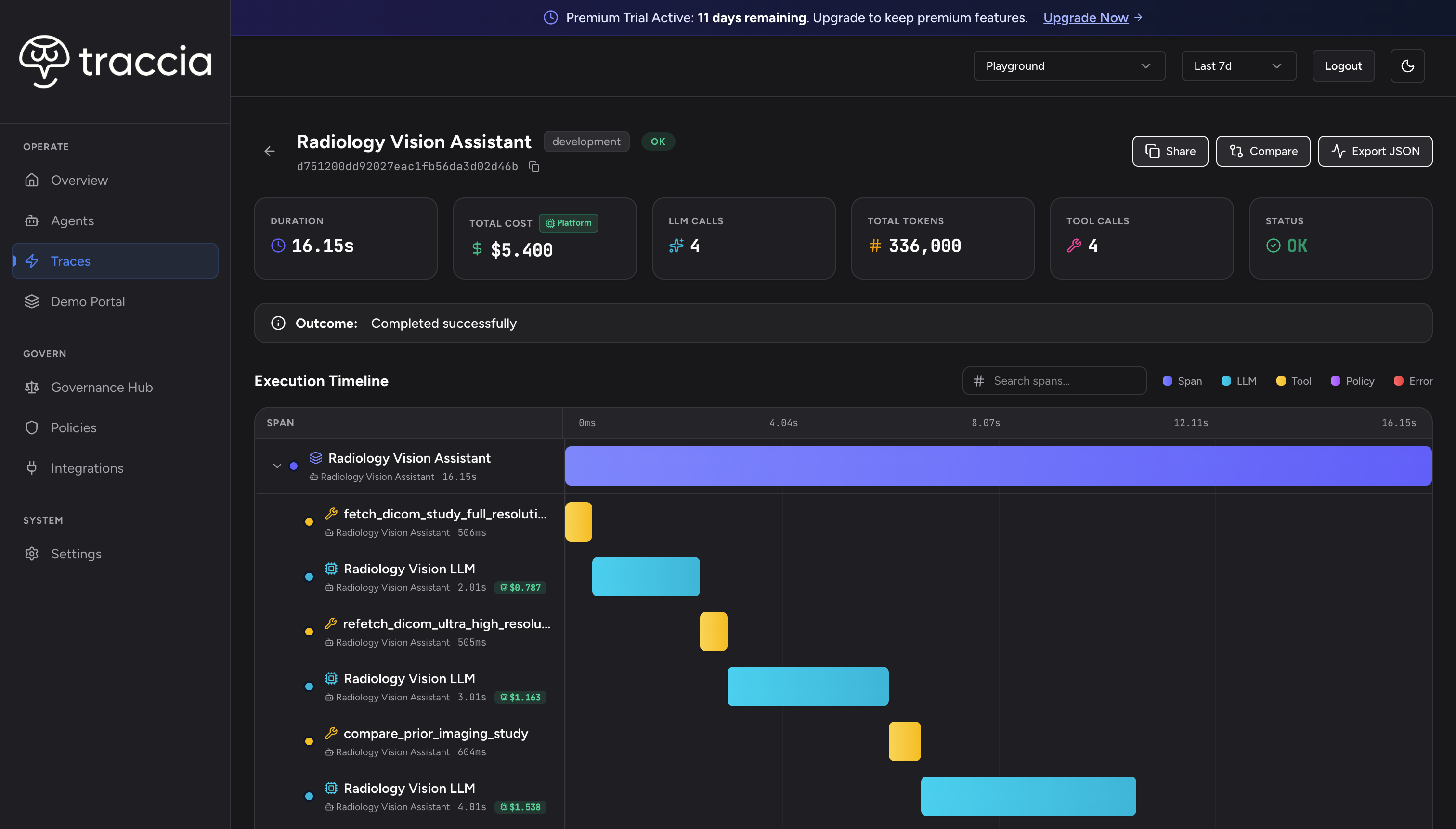
Intelligence: Cost That Survives Sampling
Arize AX calculates span and trace cost from token attributes and model pricing configs, which is solid engineering FinOps. Note from Arize’s own docs: cost is not retroactive; pricing must be configured before ingest.
Traccia’s cost model is built for production sampling realities:
- Real-time attribution per agent, workflow, and model
- Cost as OTEL metrics independent of trace sampling (accurate totals even when you sample traces heavily)
- Platform recomputation across a 2,000+ model registry when prices change, plus org-level overrides
- Cost anomaly detection for spend that is not normal
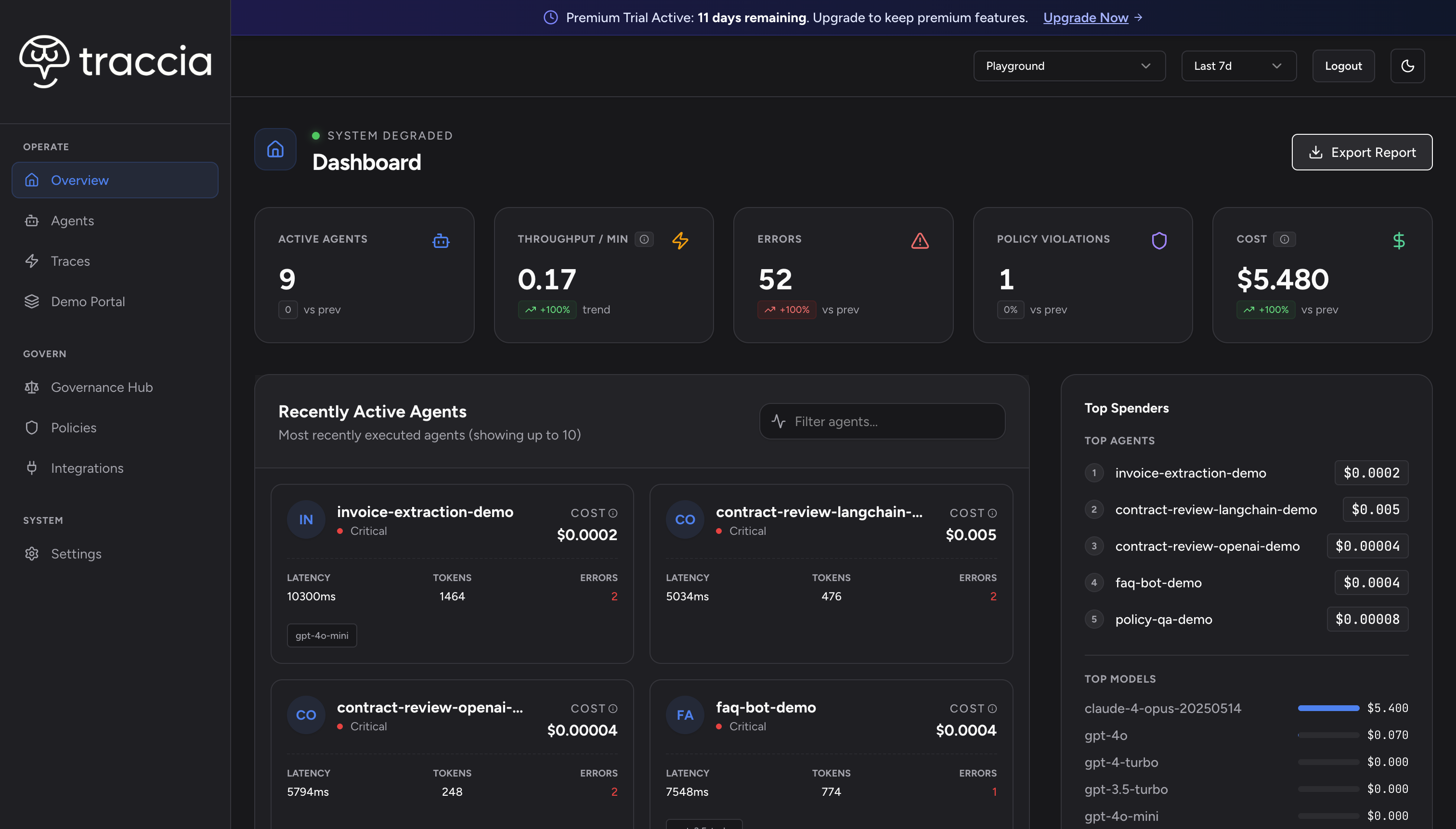
On the Overview dashboard, those totals show up next to Top Spenders by agent and model — the same cost signal ops and finance share when sampling has already cut trace volume.
Control: Enforce at the Agent Boundary
Arize AX can guardrail poor outputs (jailbreak, hallucination validators) and alert when metrics drift. That is quality control on generations. Traccia’s Control layer is about agent operational bounds.
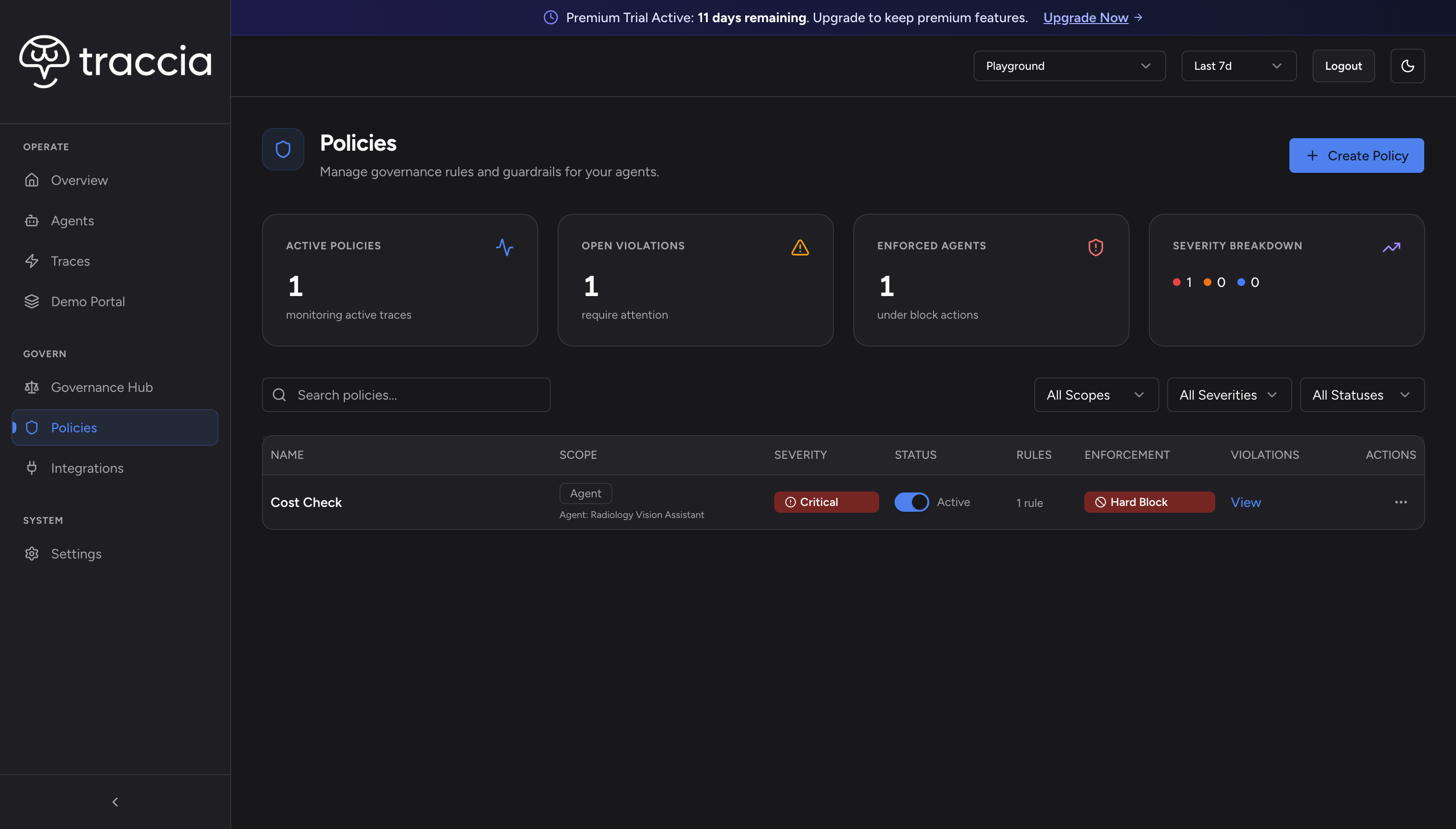
Policies that define limits
Spend Cap, Retry Protection, Duration Limit, Token Limit, and Error Rate policies flag agents that exceed thresholds as traces are ingested, so platform teams see violations immediately.
Runtime enforcement with @govern
When a hard_block violation is open, @govern checks platform agent status before the function body runs. The next invocation never enters; AgentBlockedError terminates the call. Soft blocks warn and continue. That is enforce, not just observe: the gate sits at the agent boundary after policy evaluation, not as a note on yesterday’s dashboard.
import { init, govern } from "@traccia/sdk";
init({ apiKey: "...", endpoint: "https://api.traccia.ai/v2/traces" });
export const runAgent = govern(  { agentId: "support-agent", failOpen: false },  async (prompt: string) => callLlm(prompt),);
Guardrail posture (supporting evidence)
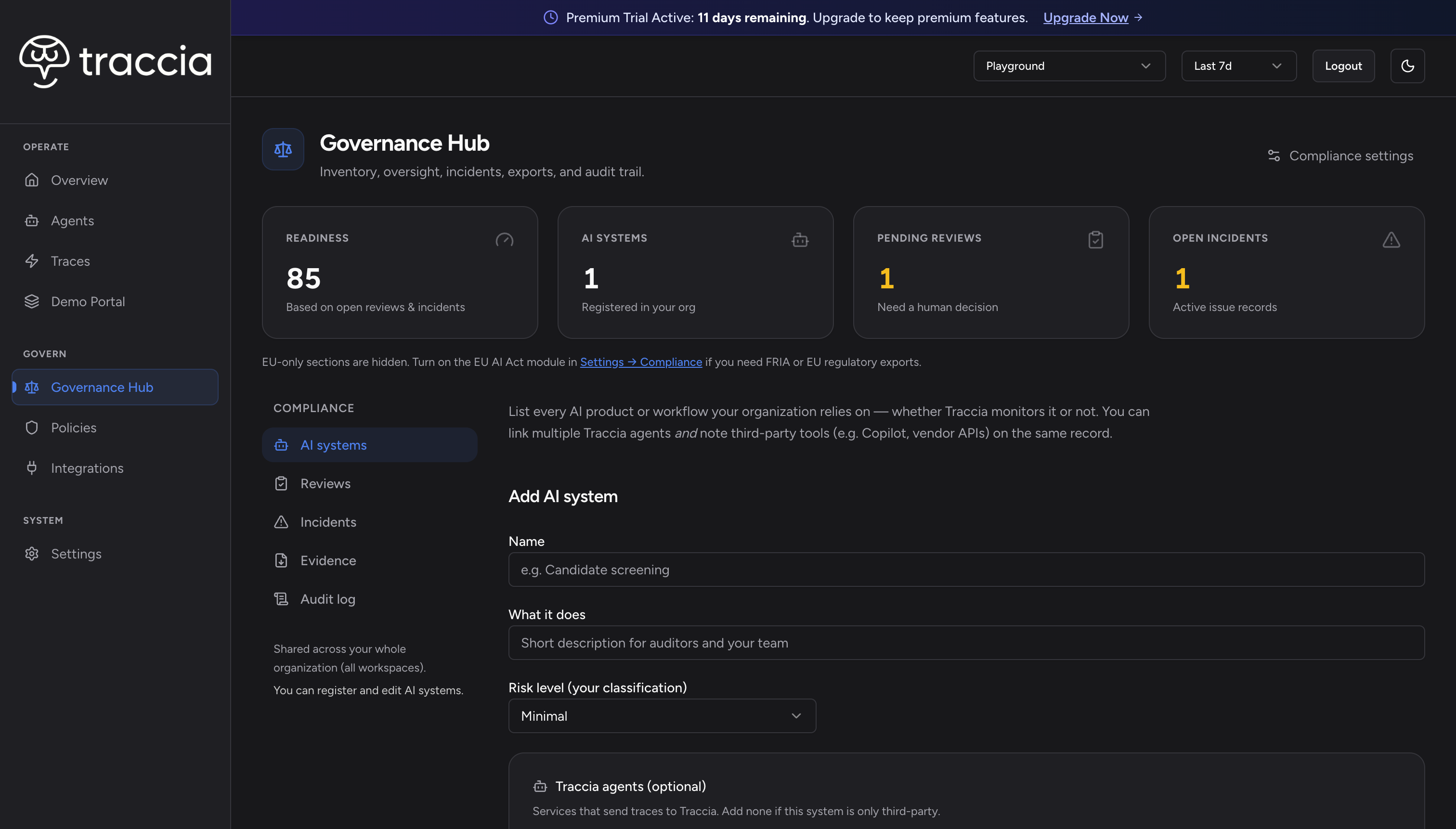
Traccia’s 3-tier guardrail detection is read-only posture: Explicit, Provider-native, Heuristic, plus missing-guardrail flags. It proves safety controls existed on a run. It is not the same as @govern hard blocks or AX-style output validators. Use it for Certification; use policies + @govern for Control.
Certification: Evidence From Live Telemetry
Arize Enterprise offers strong security certifications (SOC 2 Type II, ISO 27001, HIPAA, GDPR, PCI DSS on AX). That is organizational trust in the vendor. Traccia’s Certification pillar is different: evidence derived from your agents’ live traces for EU AI Act and HIPAA workflows.
| Capability | Arize AI | Traccia |
|---|---|---|
| EU AI Act article-mapped evidence | Not a primary product module | Evidence packs from runtime telemetry |
| HIPAA compliance support | Vendor HIPAA posture (AX Enterprise) | PHI inventory, safeguard checklists, HIPAA-labeled evidence exports |
| FRIA drafts (Art. 27) | Not a primary product module | Wizard → downloadable JSON |
| Governance Hub | Not a primary product module | Registry, reviews, incidents |
| Vendor security certifications | SOC 2, ISO, HIPAA, GDPR (AX Enterprise) | SOC 2 in progress; redaction-first design |
Traccia helps organize evidence; it does not replace legal conformity assessment or authority filings.
Where Arize AI Leads
For teams whose bottleneck is model quality and experimentation velocity, Arize remains a category leader.
- One of the most complete evaluation stacks: LLM-as-Judge, code evals, online evals, annotation, experiment comparison
- OpenInference standard and deep agent debugging UX
- Prompt and experiment workflows tightly coupled to traces
- Phoenix for free self-hosted tracing and evals
- Mature enterprise security certifications on AX
Where Traccia Leads
When production agents need operational limits and audit-ready evidence, Traccia is built for that job.
- Agent-boundary policy enforcement with @govern hard blocks
- Platform policies for spend, retries, duration, tokens, and error rate
- Sampling-accurate cost intelligence via OTEL metrics, with historical recomputation
- Versioned prompt management with Prompt Playground and SDK fetch at runtime
- EU AI Act evidence packs, FRIA drafts, and HIPAA compliance support from live traces
- OpenTelemetry-first instrumentation without a proprietary trace lock-in
Evaluations are on Traccia’s roadmap. Prompt management is now shipped. Today the differentiation is Control and Certification for production agents.
The Bottom Line
Choose Arize AI if
Choose Arize AI if you need a mature evaluation lifecycle: experiments, online evals, and deep quality debugging for LLM applications.
Choose Traccia if
Choose Traccia if you need to enforce agent bounds in production: Visibility and cost Intelligence on OpenTelemetry, Control via policies and @govern, versioned prompt management, and Certification evidence (EU AI Act + HIPAA) from live traces.
References
- Traccia (https://traccia.ai)
- Traccia Docs: Policies (https://traccia.ai/docs/platform/policies)
- Arize AI (https://arize.com)
- Phoenix (https://arize.com/phoenix/)
- Arize AX: Track Costs (https://arize.com/docs/ax/instrument/track-costs)
See Traccia on your own agents
Instrument once with OpenTelemetry, then get agent-level tracing, sampling-accurate cost attribution, guardrail verification, and runtime policy enforcement — with a free tier to start.